Christmas Party for Korean adoptee with InKAS Mentors and Volunteers
Add/Remove email notification | RSS Feed
Christmas Party for Korean adoptee with InKAS Mentors and Volunteers
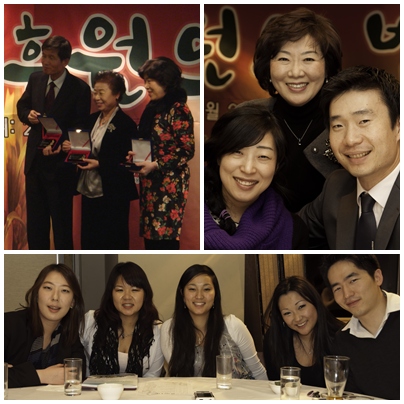
Congratulation for everybody did a good job on TESOL Course.
.jpg)
Important Notice : InKAS Office will be closed on 29th(Thursday) and 30th(Friday) of December,2011 due to arrange our office stocks and documents for this year.
Thanks for understanding in advance.
InKAS Team
Written by on date 2011-12-19 in Events .
InKAS is currently organizing a new mentoring program, our "Samchon Emo Program" (삼촌 이모 프로그램). This program will select mentors who are Korean professionals and retirees that are currently/where working as business owners, government officials, news reporters, etc. Our mentees will be Korean adoptees currently living in Korea. The purpose of this program is to provide Korean adoptees with mentors that have extensive experience working in Korea as well as the ability to receive advice, counseling, and networking opportunities if desired. In Korean, the word "samchon" means uncle, and "emo" means aunt. The reason we chose our program name to be "Samchon Emo" is because your mentor will provide a support role, much like an aunt or uncle would. Many Koreans call elders that are close to them "samchon" or "emo" even if they are not blood-related. This program will not have a specific start and end date, rather InKAS is merely providing contact information and matching the mentee with a mentor. However, this allows you to choose what kind of mentorship you would like. You can meet only once in a while to chat about general life experiences and difficulties living in Korea. Your mentor can also provide a higher level of interaction if you wish - providing counseling, career information, weekend homestay/holiday visit, or acting as a support contact during emergency situations. For those who are still finding their way in Korea, this is an excellent opportunity, particularly to those looking for a job. We are not selecting just anyone as our mentees, but successful professionals that are well-respected and well-known in their community. InKAS will also organize group gatherings for all mentees and mentors occasionally to attend holiday events, sporting events, etc. IF YOU WOULD LIKE TO PARTICIPATE AS A MENTEE, please email InKAS at: Inkas21@yahoo.co.kr for an application. Thanks for your interest!! |
2012 InKAS Korean Language Scholarships
for spring semester
Please note that the application for Seoul National University will be closed on December 31st and for all other schools you can apply until January 28th.
This is a great opportunity to learn the Korean language at a prestigious university in South Korea. InKAS provides Korean language scholarships to overseas Korean adoptees. In association with a grant from the Ministry for Health, Welfare, and Family Affairs, scholarship grantees can study at any of these language Institutes: Ewha Woman’s, Korea, Kyunghee, Seoul National, Sogang, Sookmyung and Yonsei University. Any overseas Korean adoptee over the age of 18 who can invest a semester or more of studying Korean is qualified for the scholarships.
1. Application – Required documents
- Application form
- One photocopy of adoption document with your Korean name
- One photocopy of your passport with passport number
- One photocopy of your high school graduation certificate
- One photo (3x4cm)
- One page of self-introduction
* In case this is your second term, you could submit just the application; the other documents are not necessary but may need to be sent on a special case basis to InKAS.
2. Application Dates
Starting from December 14th, first-come, first-served basis
*Only the fully-completed application along with all the required documents received between December 14th and January 28th, will be accepted. Selections will be made entirely on a first-come, first-serve basis.
*In case you had any problems academically or in any other ways in your school in any previous semesters, your application can be rejected or your acceptance can be cancelled.
3. How to Apply
① Sign-up through the InKAS website and go to the Korean Language Scholarship section:
Services -> Scholarship -> InKAS Scholarship Program Request (http://www.inkas.or.kr/eng/programs/programs02.asp)
② Submit an application form on the page and upload all the required documents on “Mypage”
*MyPage is on your right top after you log in.
4. Korean Language Schools
|
No. |
Schools |
Website |
|
1 |
Kyunghee Univ. |
|
|
2 |
Korea Univ. |
http://klcc.korea.ac.kr/main.mainList.action?langDiv=2 |
|
3 |
Ewha Woman’s Univ. |
http://elc.ewha.ac.kr/korean/en/index.asp |
|
4 |
Yonsei Univ. |
|
|
5 |
Sogang Univ. |
|
|
6 |
Sookmyung Univ. |
|
|
7 |
Seoul National Univ. |
Course period for each university
1) Kyunghee Uni. – 2012.4.2~2012.6.13
2) Korea Univ. – 2012.4.2~2012.6.13
3) Ewha Womem’s Univ. –2012.3.14 (Wed)~2012.5.23 (Wed)
4) Yonsei Univ.- 2012.4.2~2012.6.12
5) Sogang Univ.- 2012.3.6~2012.5.17
6) Sookmyung Univ. –2012.4.2~2012.6.12
7) Seoul National Univ. – 2012.3.5~2012.5.11
Generally, the classes at all the universities run from 9a.m. to 1p.m.from Monday through Friday. *Unlike last semester, unfortunately, we can’t afford to grant scholarships for any evening classes due to reduced funds. However, even though you have to cover the whole tuition on your own, if you still want to attend an evening class, you yourself can apply for it directly to the school that you want to go.
5. Fee
- Application fee to InKAS : $77 US dollar or 82,000won (You can make the payment through Paypal on the website or directly at the office)
- Tuition fee is 50% covered by InKAS Korean Language Scholarship. (excluding the registration fee to a school) In case this is your second term on the same university, you don’t need to pay the registration fee.
*Except Yonsei University, students need to pay 70% of the tuition fee.
All notices related to fees will be sent by notification individually after being chosen as a scholarship beneficiary. You will get the results sometime after the application period is ended by email, which is January 28th, 11:59pm Korean time.
If you have further inquiries regarding the InKAS Korean Language scholarships, please visit the InKAS website to check out the information or leave a message in the Q&A section.
Event date: 2011-12-14
Written by on date 2011-12-14 in Notices .
IIIHR (Inje Institute for International Human Resources) International Korean Adoptee Program is now accepting applications for the 2012 Spring semester.
IIIHR International Korean Adoptee Program is a non-profit educational institution at Inje University, located in Gimhae, Gyungnam Province, Korea. The program was founded in 2001 and has hosted over 230 Korean Adoptees from 17 conturies.
The Semesters are 15 weeks and will start on March 1st, and June 7th. The tuition fee is only $600 USD and it covers classes, housing(dormitory), cafeteria meals (breakfast, lunch, dinner) and day trips to cultural and historical sites in Korea.
The classes are approximately 15 students in size and are taught in English. Students will live on campus with a Korean roommate, and attend Korean Language, Culture, Cooking, Movie, Music, and Taekwondo classes. They will also participate in weekly English Conversation groups. In addition, IIIHR participants have access to Inje University’s weight training gym, library, and multimedia resources.
If you are interested in IIIHR Program you can contact Kim Ji Hye. Kim Ji Hye is the IIIHR International Adoptee Program Coordinator. If you have questions you can contact us at iiihr@hotmail.com. You can also visit our website at www.iiihr.net for more information.
Inje University
Korean Adoptee Program Coordinator
Kim Ji Hye
82-55-320-3755~6
| Hello, It’s that time of the year again…the InKAS Christmas Party!!! InKAS would like to invite all Korean adoptees to come celebrate the holidays with us on Friday, December 23rd on the 18th floor of the Korea Press Center. ***(Please note because of limited seating we will be giving first priority to Korean adoptees) We will have three separate events held that evening: 2:30pm-5:30pm Career informational session: We will have several speakers discuss tips on opening your own business, information on completing taxes in Korea, and also many representatives of English schools will come. If you are currently looking for an English teaching position, you can bring copies of your resumes as well as a short cover letter to give to representatives. 6pm Our InKAS TESOL Certification Class will have their graduation! All participants that successfully passed the TESOL Course will have a ceremony and receive their certificates at this time. 7pm Christmas Dinner and Party: PLEASE RSVP TO Inkas21@yahoo.co.kr IF YOU WILL ATTEND THE DINNER, WE HAVE LIMITED SEATING. This dinner is FREE. There will be a delicious Western-style and Korean-fusion buffet with music performances starting at 7pm. We hope you all can come!! When you RSVP please let us know which events you will attend, thank you! Directions: For a map, use this link: http://me2.do/GyZCGq You can get off at City Hall (blue line) and take exit 4, walk straight and the Press Center will be on the right (letter A on the map) You can also come from exit 1 or 2 from Ulgiro 1-ga (green line) You can also come from exit 5 at Gwanghwamun (purple line) |
Written by on date 2011-12-06 in Pictures .
Here are some of our recent events!
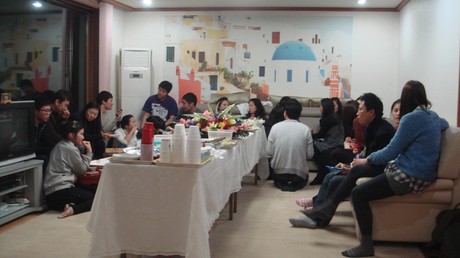
Our Thanksgiving dinner at the InKAS Guesthouse!
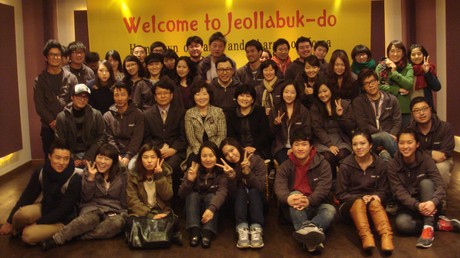
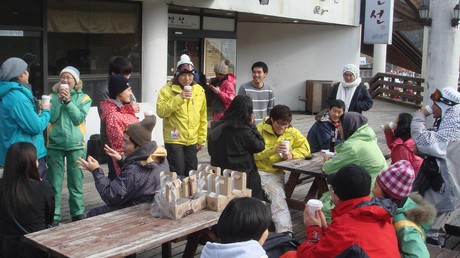
Our InKAS Winter Leadership Workshop to Jeonju and Muju Ski Resort!
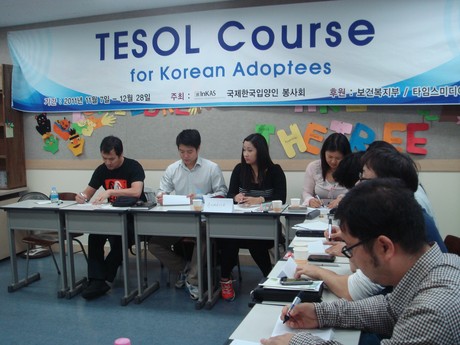
Our first TESOL certification class will be finishing in about two weeks!
Event date: 2011-11-18
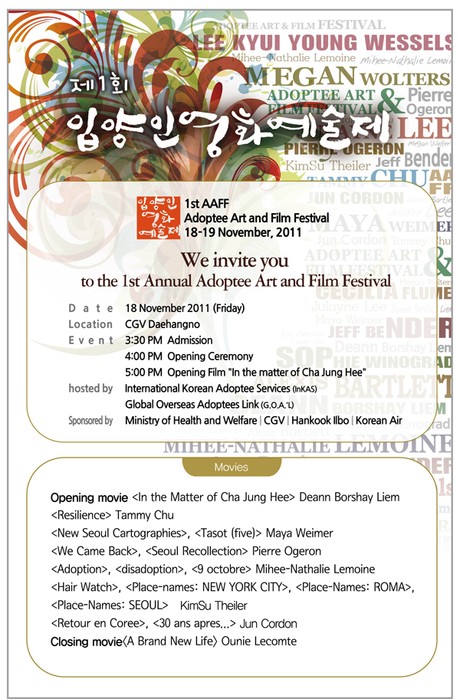
We invite you on 1st AAFF(Adoptee Art and Film Festival) !!!
If you want to attend, you need to contact us at inkas21@aaff.co to be placed on the invitation list. The event is free for all adoptees on the invitation list(Please specify in your email if you are an adoptee)
Please make sure that you should write an email title "AAFF attending"
Thank you!!
INKAS 2011 THANKSGIVING DINNER
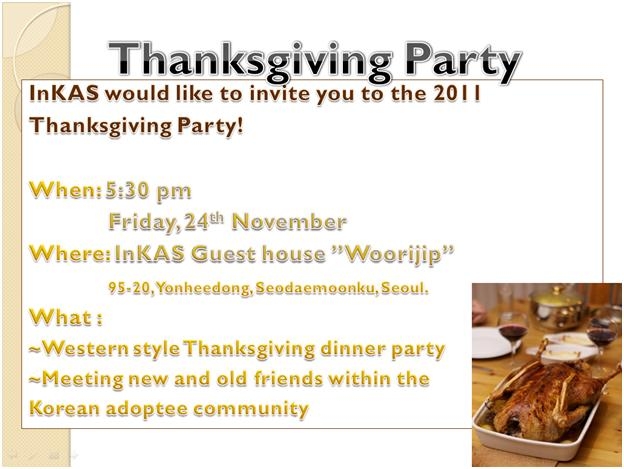
We would like to invite any Korean adoptee living in Korea to come to our annual Thanksgiving dinner. There is 20 spots available, so please email us (inkas21@yahoo.co.kr) if you want to attend - we will select the spots based on a first come - first serve basis. This is a great opportunity to meet new people in the adoptee community as well as catching up with some old friends.
Hope to see many of you there!
Winter Leadership Workshop
2nd ~ 4th Dec
This is the news that you have been waiting for! 2011 InKAS Winter Trip!!!
The purpose of this program is to provide an opportunity for Korean adoptees living in South Korea and elsewhere to learn about South Korea’s diverse culture.
This year’s InKAS Winter Trip will be held in JeollabukDo(전라북도), one of the southwest districts of Korea. During this trip, we will have several exciting activities such as a tour of a historic site at Jeonju / Ski & Spa at Mooju and seminars on lifestyle and career opportunities in Korea.
Jeolado is the most famous province for Korean food in Korea. Especially, JeollabukDo is well known for Jeonju Bibimbob. Also, we will take a tour of historic artifacts of the 500-year-old Chosun dynasty and explore the Mooju area with its nature-friendly tourist attractions.
Join us in this time of excitement!!
Application deadline: November 26th, 6pm
How to apply: You need to be an InKAS member to apply. Please sign into your InKAS account and under “My Applications” fill out the 2011 Winter Recruit Trip.
Who can apply: 35 Adult Korean adoptees! Only the first 35 people who apply can join this trip!
Workshop Fee: 30,000 won
Friday Schedule
1300: depart from Sinchon to Jeollabukdo
1500: arrive at Jeonju
1600: Recruit Seminar I in Jeollabukdo Provincial Office
1730: dinner with Joenbuk University students
2000: free time with Jeonbuk/Joen Nam University students
Saturday Schedule
800: breakfast
900: Joenju Folk Village tour
1200: lunch (bimbimbap)
1300: depart to Mooju
1500: hike Mt. Duckyoo (riding a gondola)
1700: Recruit Seminar II
1730: dinner
1830: Recruit Conference
2000: free time
Sunday Schedule
700: breakfast
800: ski or sauna
1200: lunch
1300: ski or sauna
1700: come home :)
Event date: 2011-11-18
Written by on date 2011-11-09 in Events .
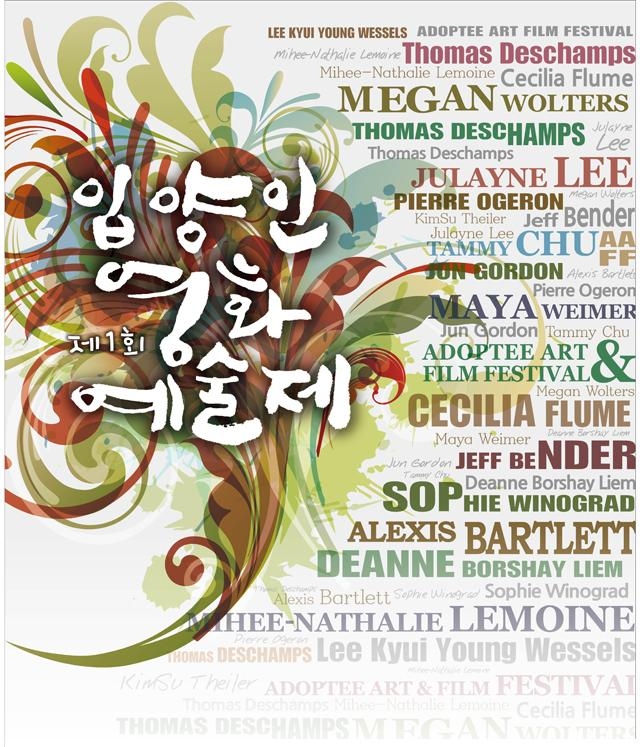
Adoptee Art and Film Festival held in Seoul hosted by InKAS and GOAL!
Date: November 18th & 19th (Friday and Saturday)
Location: Daehakno CGV Theater - located at Hyehwa station, exit 4.
Walk towards your left down the small street past Paris Baguette and a
little further down the CGV will be on your right.
For the Korean version of this event please view the link:
https://www.facebook.com/event.php?eid=251663381547429
IMPORTANT:
If you want to attend, you need to contact us at inkas@aaff.co to be
placed on the invitation list. The event is free for all adoptees on
the invitation list, and for non-adoptees there will be a donation box
at the entrance.
Please look at the following link for the film schedule as well as information on each film and filmmaker: http://aaff.co/
This is really an amazing opportunity, and we hope to see you there!
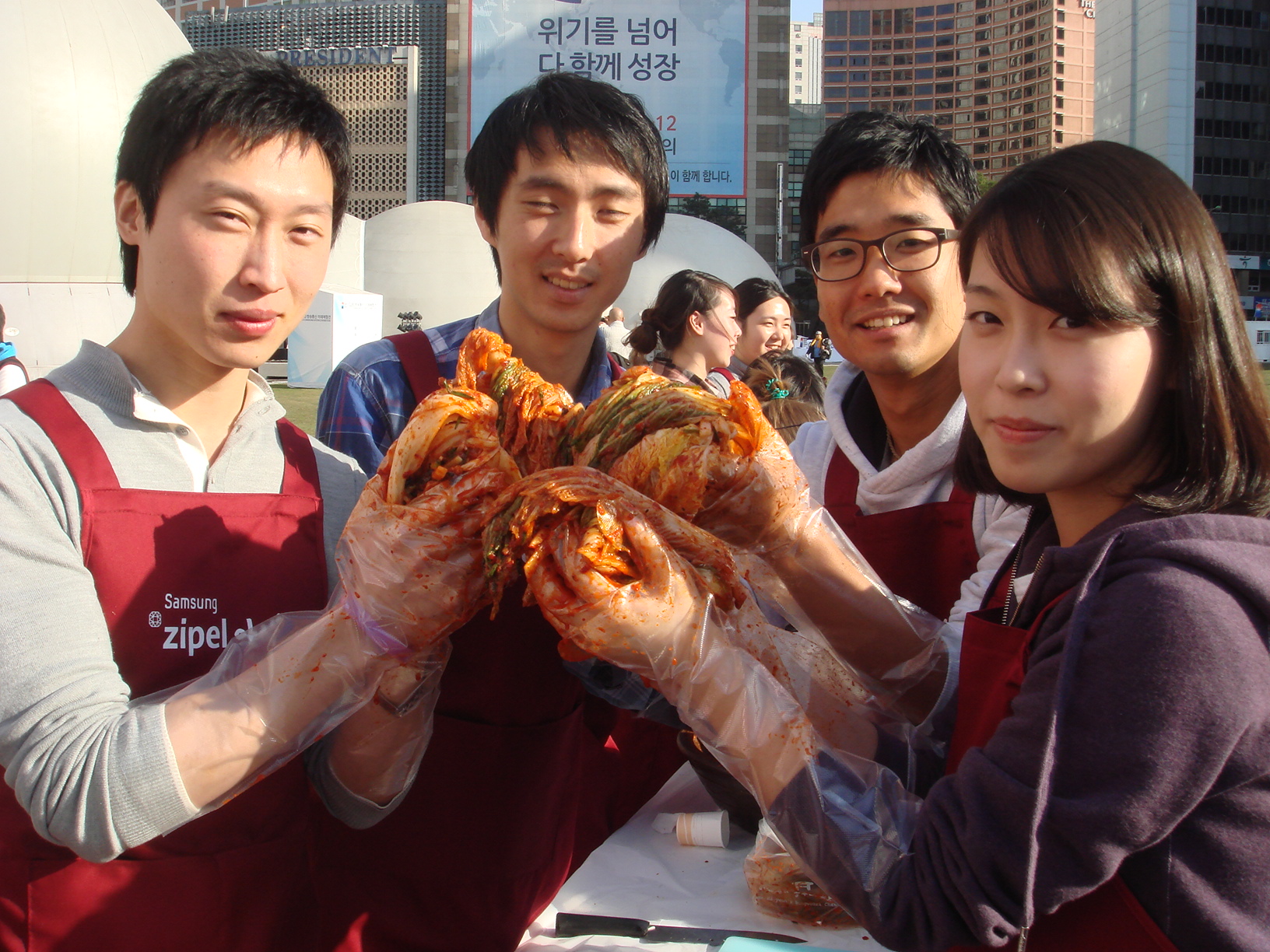
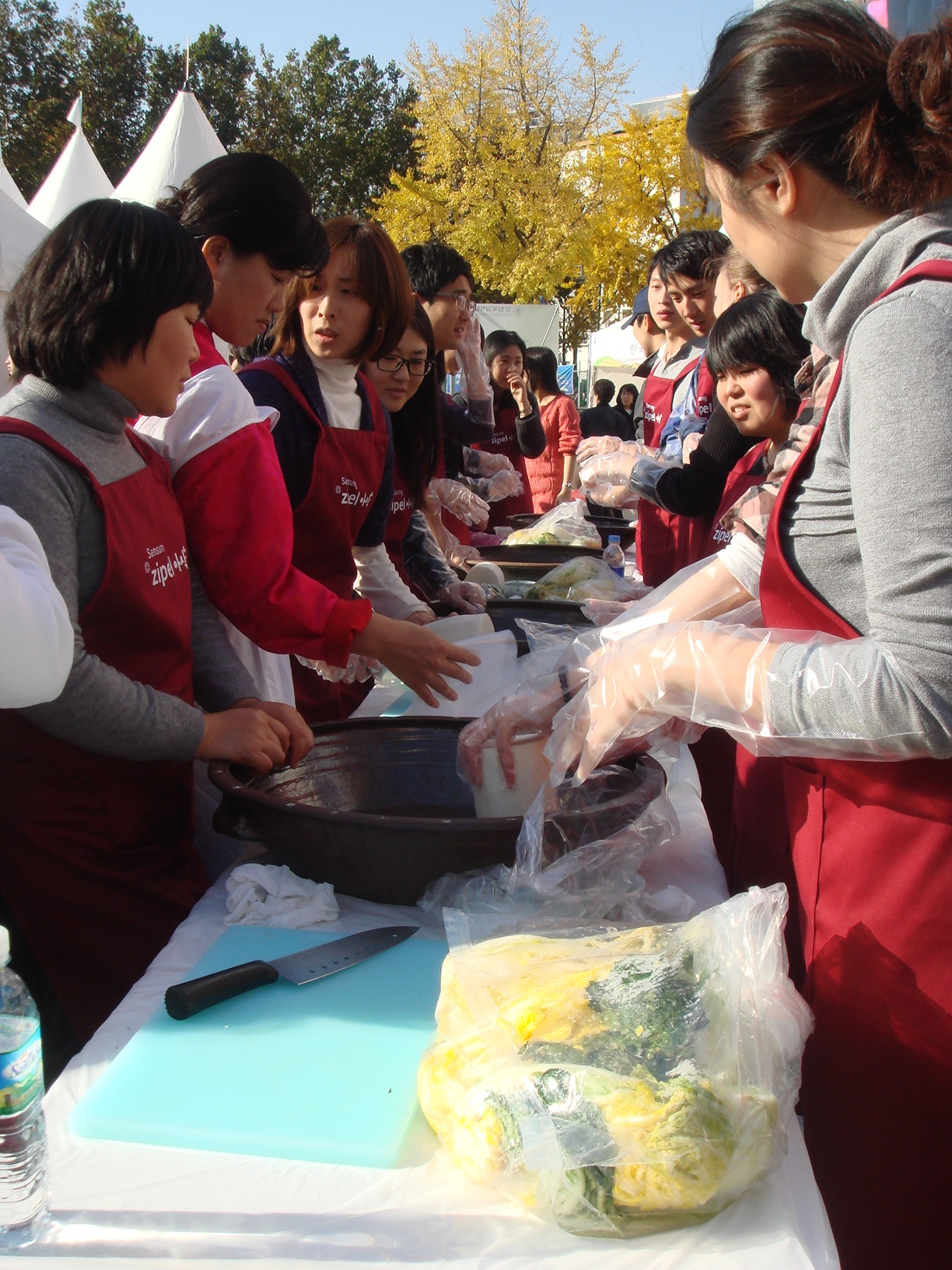
KIMCHI FESTIVAL!!!
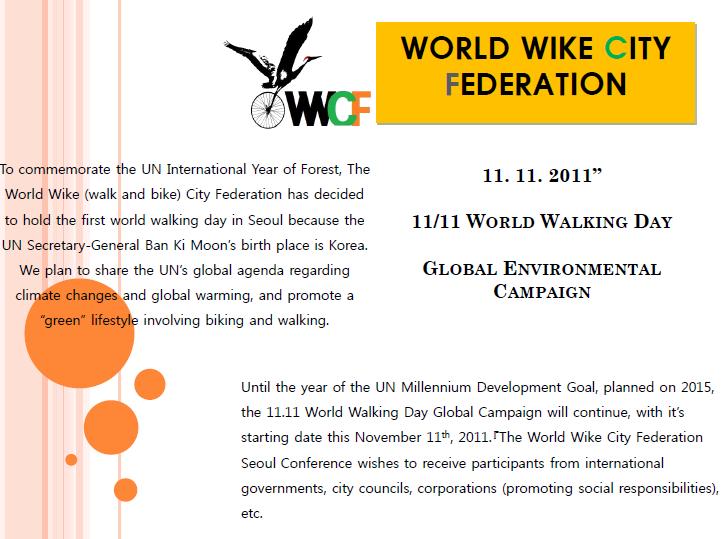
InKAS would like to invite all Korean adoptees to the first World Walking Day. This event is being held by the World Wike City Federation and supported by the United Nations. The Walk will last from 11:11am to noon. After the Walk there will be a
free homemade hamburger lunch. Many people representing different
communities in Korea will be participating in the Walk as well, even TV
stars!!
We will meet at 11am at Gwanghwamun Station, exit 5.
Please come to the statue that looks like a unicorn horn beside the
Cheong gye cheon.
See you all there!!!
Dear InKAS Members,
You are invited to our 8 week TESOL Certification Class
TESOL = Teaching English to Speakers of Other Languages.
This is a great opportunity to get a teaching certificate!! This class is free, except for a registration fee (this class usually costs around 2 million won).
Why should you get a TESOL Certificate: Most Korean public and private schools prefer an English teacher with a teaching certification, and you also have the opportunity to receive a higher salary than teachers without a teaching certificate. The TESOL certification is through the Korean Herald, one of the most well-known institution in Korea. And of course through the TESOL certification class you can gain valuable experience and teaching methods that will enable you to become a better, more confident teacher.
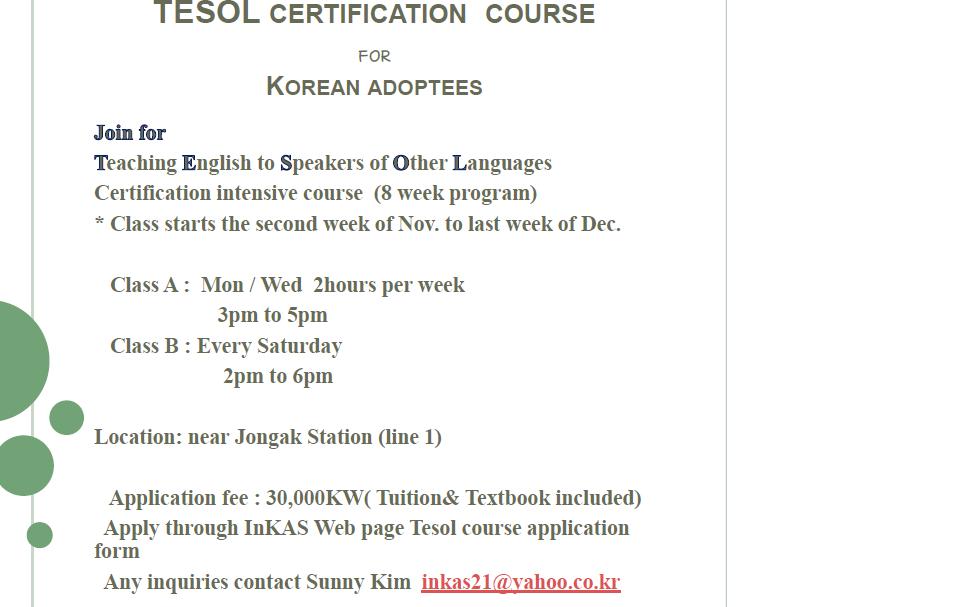
Please apply this week, deadline is Friday the 4th, as you can see there are two class options: weekdays or every Saturday.
Note: you need to be an InKAS member to access the TESOL class application, if you are not a member ane would like to become a member please email us!
Written by on date 2011-09-15 in Notices .
This is a great opportunity to learn Korean language at a prestigious University in South Korea. InKAS provides Korean language scholarships to overseas Korean adoptees. In association with a grant from the Ministry for Health, Welfare, and Family Affairs, scholarship grantees can study at any of these language Institutes: Ewha Woman’s, Korea, Kyunghee, Seoul National, Sogang, Sookmyung and Yonsei University. Any overseas Korean adoptee over the age of 18 can invest a semester or more of studying Korean is qualified for the scholarships.
- Application form
- One photocopy of adoption document with your Korean name
- One photocopy of your passport with passport number
- One photocopy of your high school graduation certificate
- One photo (3x4cm)
- One page of self-introduction
* In case this is your second term, you could submit only application and all the other documents are not necessary but sometimes needs to be sent by InKAS’s request.
Starting from September 15th, first-come, first-served basis
*Only fully-completed application along with all the required documents after January 11th in Korean time will be accepted. Selections will be made entirely on a first-come, first-serve basis.
*In case you had any problems academically or in any other ways in your school in any previous semesters, your application can be rejected or your acceptance can be cancelled.
? Sign-up through the InKAS website and go to the Korean Language Scholarship section:
Our Services -> Scholarship -> Language school ->Click <Apply for scholarship> -> Scholarship Winter
? Submit an application form on the page and upload all the required documents on “Mypage”
*MyPage is on your right top after you log in.
|
No. |
Schools |
Website |
|
1 |
Kyunghee Univ. |
|
|
2 |
Korea Univ. |
http://klcc.korea.ac.kr/main.mainList.action?langDiv=2 |
|
3 |
Ewha Woman’s Univ. |
http://elc.ewha.ac.kr/korean/en/index.asp |
|
4 |
Yonsei Univ. |
|
|
5 |
Sogang Univ. |
|
|
6 |
Sookmyung Univ. |
|
|
7 |
Seoul National Univ. |
1) Kyunghee Uni. – Dec. 19th ~Feb. 28th
2) Korea Univ. – Jan. 9th ~Mar. 22nd
3) Ewha Womem’s Univ. – Dec. 6th~Feb. 22nd
4) Yonsei Univ.- Jan. 9th~Mar. 21st
5) Sogang Univ.- Dec. 1st~Feb. 17th
6) Sookmyung Univ. – Jan. 9th~Mar. 23rd
7) Seoul National Univ. – Dec. 5th~Feb. 10th
Basically classes of all the universities run at 9a.m. to 1p.m.from Monday through Friday. *Unlike last semester, unfortunately, we can’t afford to grant scholarship for any evening classes due to reduced fund. However, even though you have to cover the whole tuition on your own, if you still want to attend an evening class, you yourself can apply for it directly to the school that you want to go.
- Application fee to InKAS : $77 US dollar or 82,000won (You can make the payment through Paypal on the website or directly at the office)
- Tuition fee is 50% covered by InKAS Korean Language Scholarship. (excluding the registration fee to a school) In case this is your second term on the same university, you don’t need to pay the registration fee.
*Except Yonsei University, students need to pay 70% of the tuition fee.
All the notice related any fees will be notified individually after your being chosen as a scholarship beneficiary. And you will get to know the results after the application period is ended, which is October 15yth by email.
If you have further inquiries regarding the InKAS Korean Language scholarships, please send an email to InKAS(inkas21@yahoo.co.kr)
Hello,
We will be closed during the weekend as usual, as well as on Monday and Tuesday (through September 13th) for the Korean holiday Chuseok. We will resume normal office hours on the 14th.
Please note if you email or call us during the holiday that we will not be able to respond until the 14th. Thank you for understanding and for those of you celebrating Chuseok, have a great holiday!!
Written by on date 2011-08-29 in Events .
We would like to invite you to apply for our Mentor Mentee Program. Please take a look at the invitation below. We are really excited to share this opportunity with you!
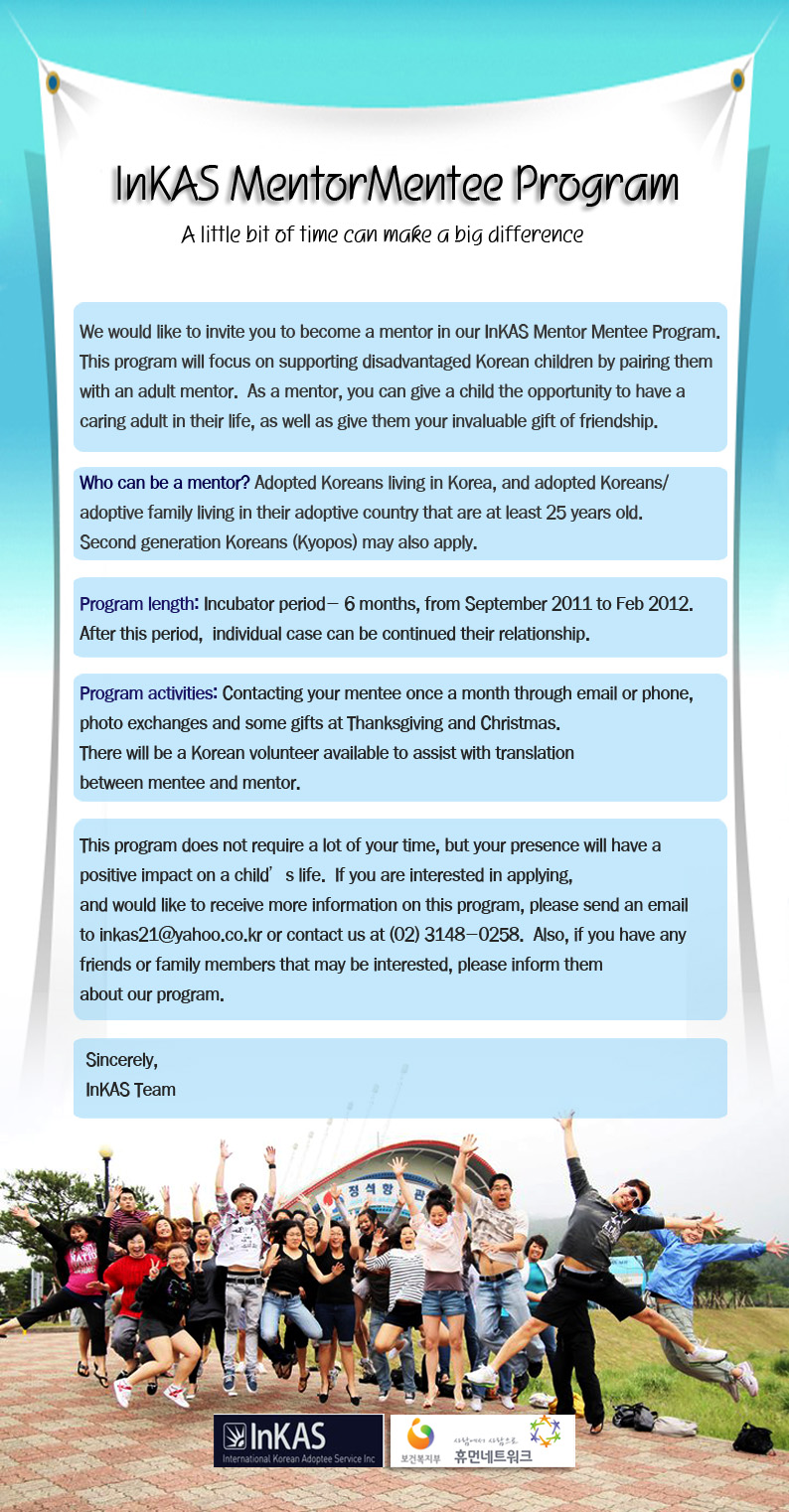
If you are interested in applying please send an email to Inkas21@yahoo.co.kr and we will provide you with an application form.
Written by on date 2011-08-17 in Events .
Dear InKAS Members,
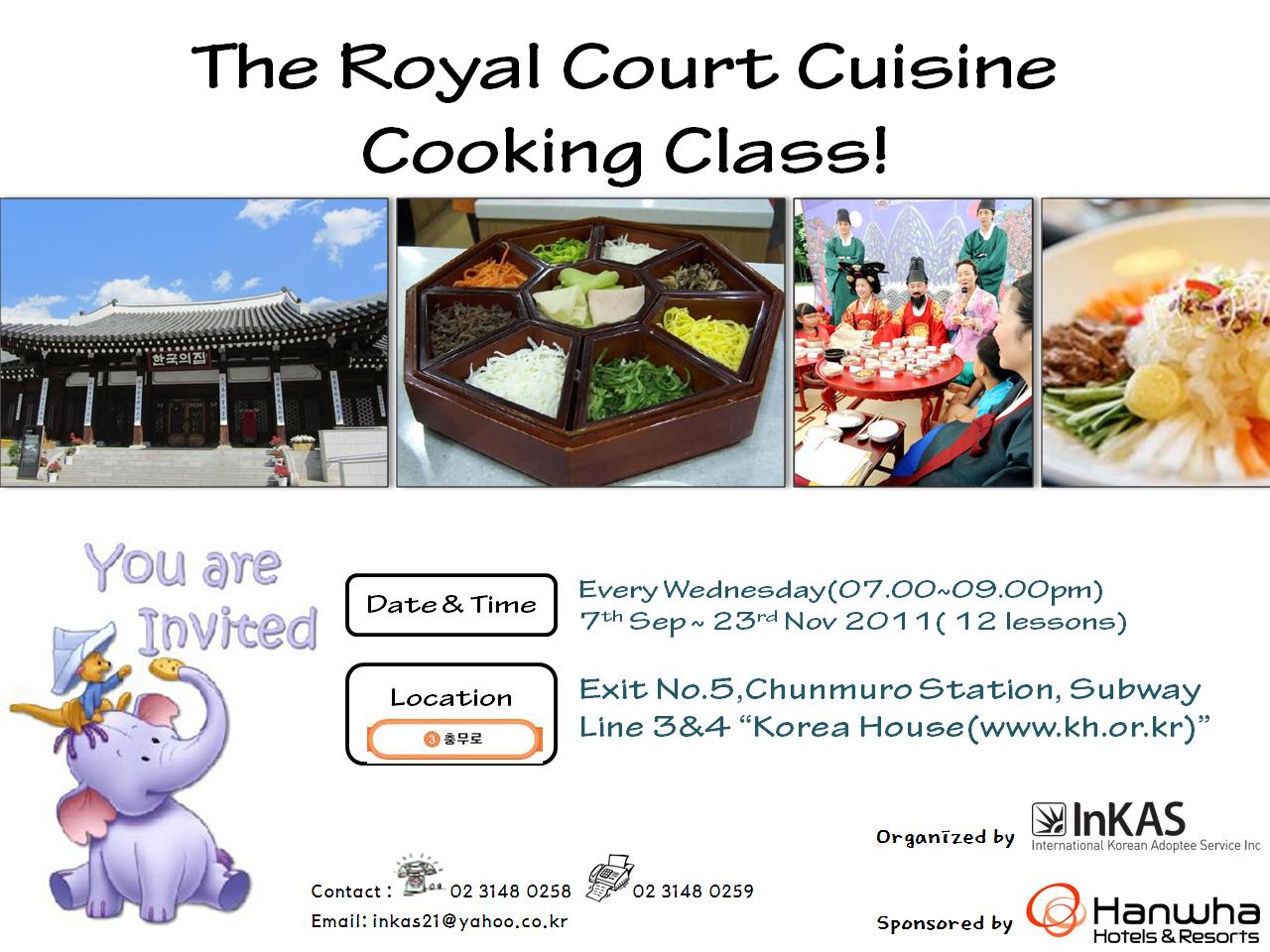
We will be starting our new cooking class on Wednesday, September 7th at a NEW location. There are 12 sessions, and we ask that all participants attend a majority of the classes. The classes will be held each Wednesday and will run until the end of November.
The class is for InKAS paid members only. The registration fee is 10,000 won. If you have already registered and paid for the previous cooking classes then you do not need to pay the registration fee again.
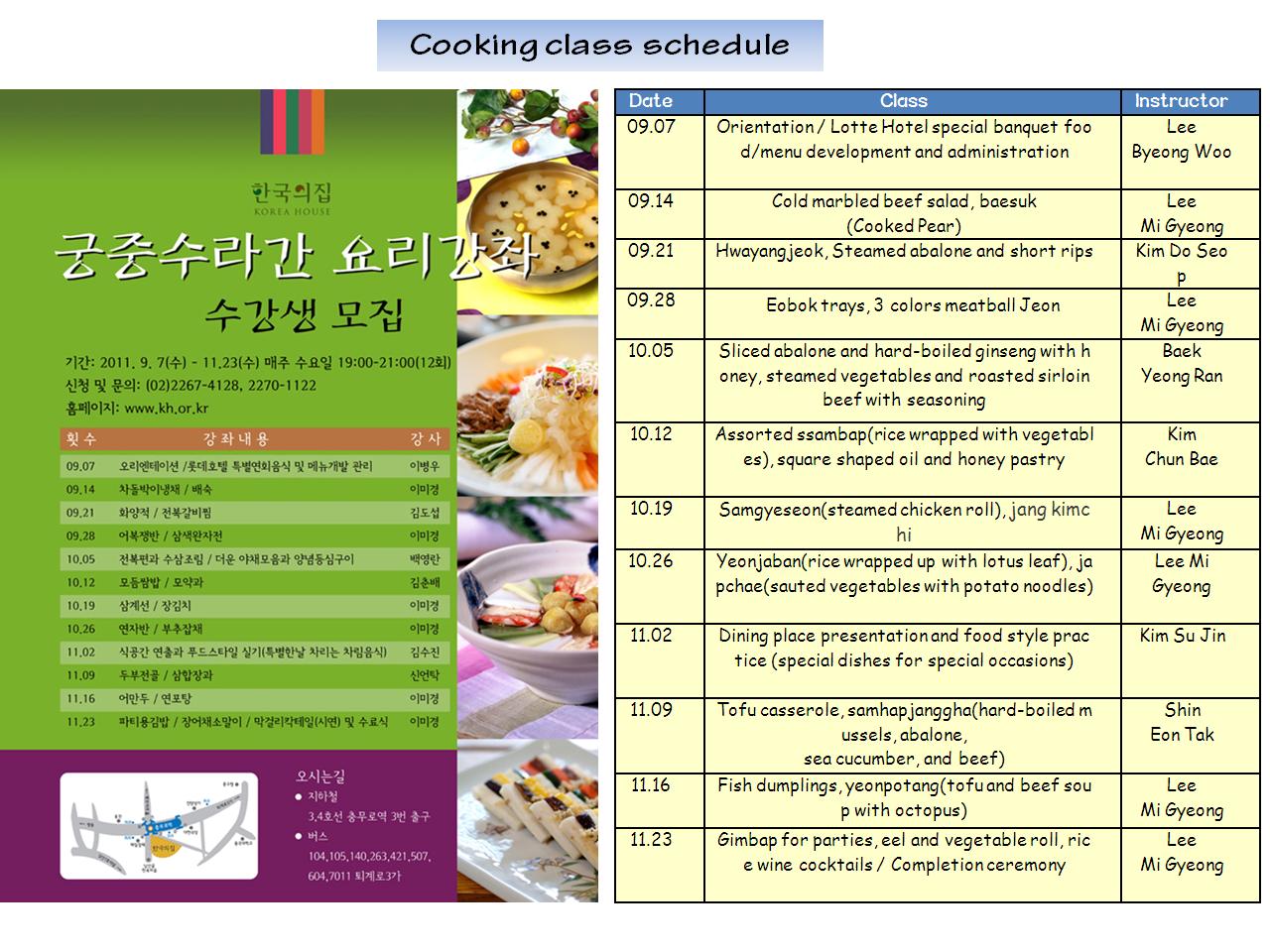
There are a couple of differences between the old cooking class and the new cooking class. First, the new class will run 2 hours, from 7pm-9pm. Also, instead of a Korean fusion style, the new place will focus on more of a traditional style. Finally, the new cooking class will involve more preparation time and learning, whereas the previous place most of the ingredients were pre-prepared.
Below are directions to Korea House and a menu for the entire cooking class course. We hope you will participate in this great opportunity and learn how to cook delicious Korean dishes! Please email inkas21@yahoo.co.kr if you would like to sign up, and we will send you an application form.
Event date: 2011-07-28
Written by on date 2011-07-20 in Events .
You and your friends are invited to a free showing of the 1974 "어제 내린 비" - "It Rained Yesterday" The film is about the dramatic lives of three young adults living in Korea during the 1970's and involves a complex love triangle between a couple and their friend.
The movie will be shown on July 28th at 1pm near the World Cup Stadium. (see link below for directions)
The director of the film will be present at the movie showing because he intends to create a new film based on the real life of the main character in 어제 내린 비. Part of the new film will include a recording of the people watching 어제 내린 비 on July 28th, so if you come to the movie showing you will be included in the director's new film! Therefore, for regulatory reasons we need a complete list of the people who will come, so please let us know by email or facebook if you will come, thanks!
Hope to see you all there!!
Link to movie summary (in Korean only) http://movie.naver.com/movie/bi/mi/basic.nhn?code=22093
Directions to the Korean Film Archive building http://koreafilm.org/kofa/visitingus.asp
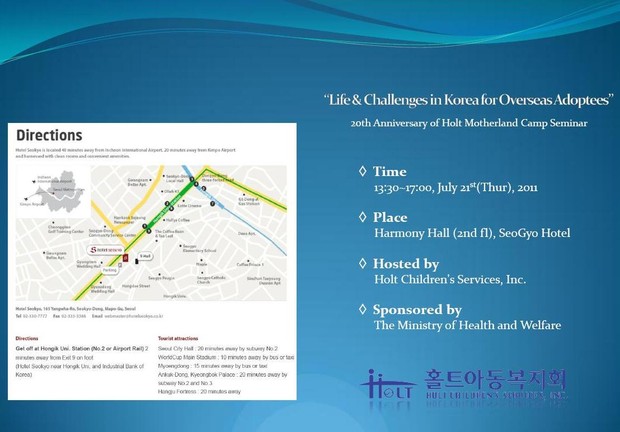
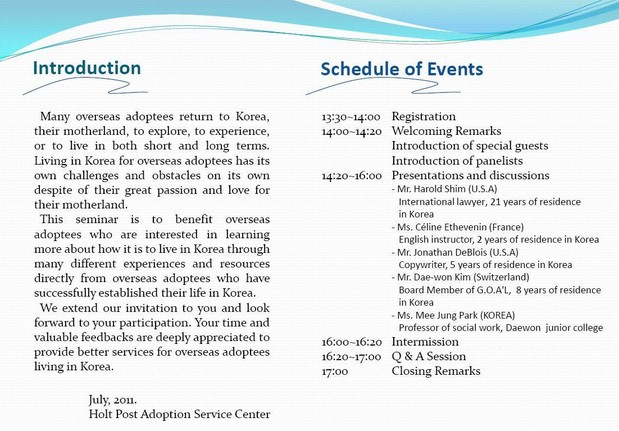
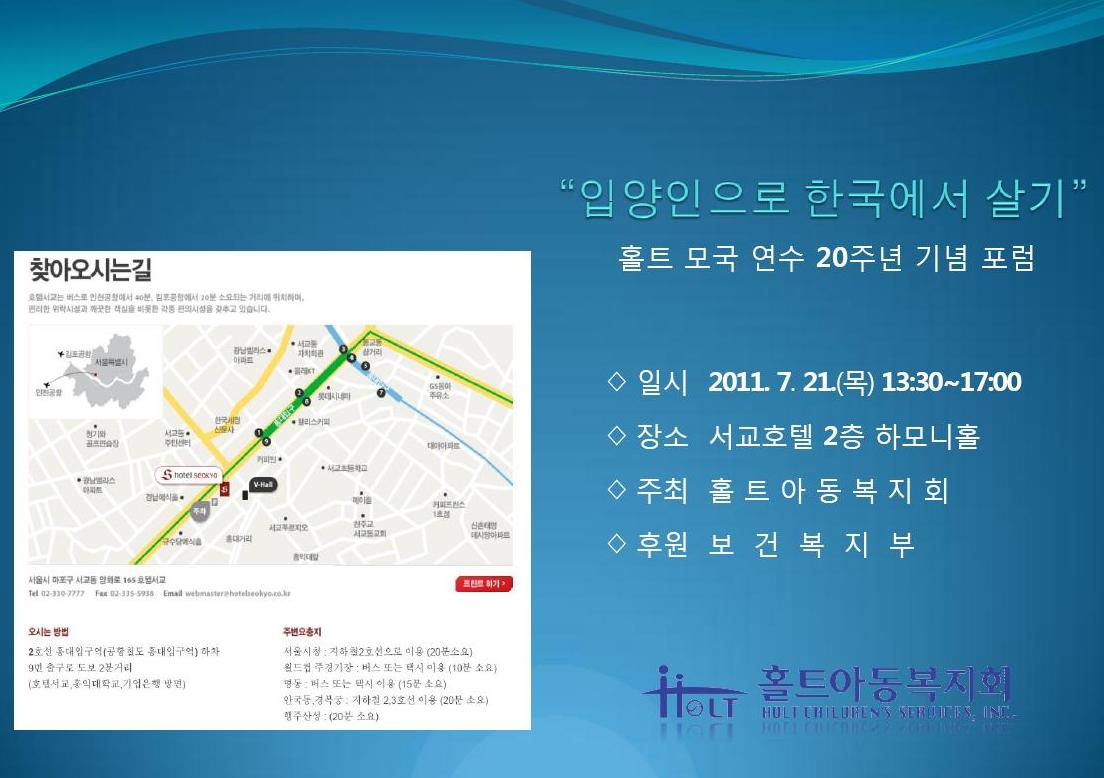
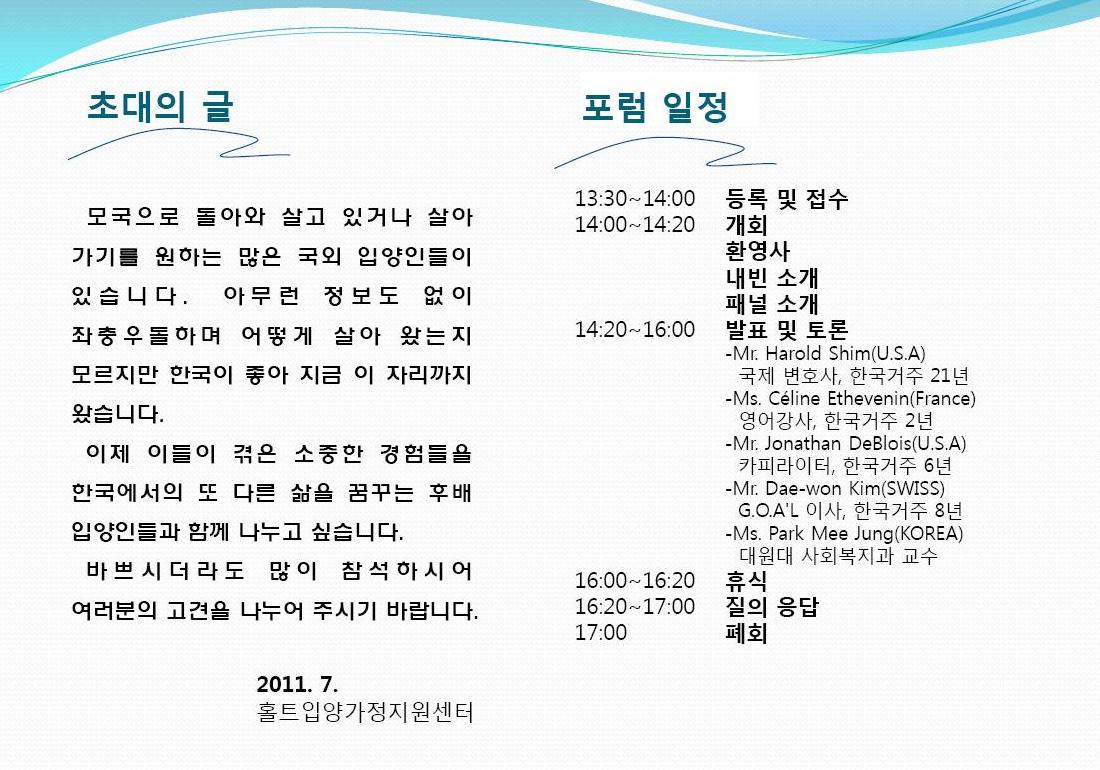
Tomorrow there will be a seminar hosted by Holt for overseas adoptees currently in Korea. The seminar will include several presentations by guest speakers as well as discussion and Q&A time later. The event will focus on providing informational resources to adoptees living in Korea, either short-term or long-term, by sharing the experiences of several adoptees who have been successful in living and working in Korea.
Anyone is invited to attend the seminar, the date is: July 21st from 1:30pm - 5pm on the 2nd floor of the SeoGyo Hotel (near Honkik University). Please see attached document for detailed directions.
Hope to see you all there!
InKAS & Jeong-no District will be holding a 3-day culture camp in Seoul during the first week of August.
When: starting time: 1pm Friday August 5th, ending time: 5pm Sunday August 7th.
Who: Korean college students and adoptees (similar age groups) (20+20 total 40 participants)
There will be about 20 Koreans, 10 adoptees, and 10 foreigners
Purpose: to promote the rich culture of Seoul through group activities and culture exchange
Detail: Jeong-no District has recently developed a new Smart-phone application for tourism. In efforts to promote this new smart-phone application, InKAS and Jeong-no district will hold a 3-day culture camp introducing the historical beauty of Jeong-no.
ex. Kyung-buk Palace, Insadong, Kwang-Hwa Gate, etc.
Fee: None
We will stay overnight Friday and Saturday:
1st Night: “북촌 한옥마을” [Traditional Hanok (Korean House) Experience]
2nd Night: “Fraiser Suite Insadong”
Written by on date 2011-06-22 in Notices .
Dear All InKAS members,
This year marks InKAS’ 12 years of devoted service to the Korean Adoptive community at large. Unfortunately due to the Ministry of Social Welfare’s unexpected budget cut for post adoption agencies, such as InKAS, we are publically announcing our service downsizing.
In order to amplify the efficiency of our post adoption services, we will be centralizing our reduced labor force towards more professional and urgent tasks headed towards new change for the future of this adoptive community. Our hope is to soon enough retain more budgets so that we can reestablish some of our lost services and extend our services even greater than before.
However for the time being, it is with regret that InKAS will be temporarily eliminating some our most favored services, such as:
1. BIRTH SEARCH
2. Haircut Service
3. Rental Phone Service
4. Bank service
These services we have currently eliminated, are services that will now be attended at your own disposal.
InKAS recognizes that our most sought after services are the birth search requests. However, please understand that this service will be no longer offered. We will only assist you with translation services and counseling services needed for the reunion meeting.
InKAS is sorry to inform you of our unfavorable circumstance and we hope to assist you better in the near future.
Sincerely,
President Aie Ree Jung
2011 Global Korean Summer Camp "Korea Loves Us(KLU)"
A big run of 12 days from May 27th to June 7th, 2011, in Motherland
All the forty participants had a meaningful time through 2011 InKAS GK Summer Camp titled Korea Loves Us. We set foot on every corner of Korea starting from Seoul, to Jeju, Busan, Kyungju, Junju, and back to Seoul and experienced the past, the present and the future of our country, filling the every moment with clues(=KLU) about how much Korea loves us.
All the splendid time spent together was precious and important for all the adoptees in the camp to fulfill their dreams as Global Koreans.

Event date: 2011-05-23
Written by on date 2011-05-21 in Notices .
2011 InKAS Korean Language Scholarships
for Fall semester
InKAS give you an official announcement of changes on Korean language Scholarship from Fall semester 2011. InKAS Language scholarship has been supported by the Ministry of Health and Welfare and each seven Universities to cover your tuition fees until now.
We are so sorry to inform you the official changes about over 50% of reduction of supporting for 2011 scholarhip to all the Scholarship receivers. We got the final reporting about scholarship supporting from the Ministry of Health and Welfare in this week, we kindly ask you for understanding our situation
--------------------------------------------------------------------------------
The changes of Language scholarship
(From Fall semester receivers of 2011)
* 100 % scholarship covered -> changes to 50% will be cover
0 % of student 's payment -> changes to 50% of student's payment
20% of student's payment for Yensei University -> changes to 70% student's payment
--------------------------------------------------------------------------------
1. Application – Required documents
- Application form
- One photocopy of adoption document with your Korean name
- One photocopy of your passport with passport number
- One photocopy of your high school graduation certificate
- One photo (3x4cm)
- One page of self-introduction
2. Application Dates
Starting from May 23rd - Jun 5th.
*Only fully-completed application along with all the required documents after May 23rd in Korean time will be accepted. Selections will be made entirely on a first-come, first-serve basis.
3. How to Apply
Sign-up through the InKAS website and go to Our Services -> Scholarship -> apply for scholarship button ->find the application of scholarship fall -> Fill it out and upload all the required documents
->Submit
4. Check out Korean Language Schools in advance
Schools Website
1. Kyunghee Univ. http://eng.iie.ac.kr/
2. Korea Univ. http://klcc.korea.ac.kr/english/index.php
3. Ewha Woman’s Univ. http://elc.ewha.ac.kr:1004/en/index.asp
4. Yonsei Univ. http://www.yskli.com/index.asp
5. Sogang Univ. http://klec.sogang.ac.kr/
6. Sookmyung Univ. http://www.lingua-express.com/main.jsp?idx=070101
7. Seoul National Univ. http://language.snu.ac.kr/site/en/klec/main/main.jsp
5. Qualification
- Korean Adoptee (graduate high school or higher)
- InKAS Paid membership (30$ or 33,000KRW/year)
6. Fee
- 50% of each school’s tuition
- Text book
*Except Yonsei University, students need to pay 70% of the tuition fee.
Please send us an E-mail if you have further inquiries about Korean Language scholarship.
InKAS
Finally, on the May 27th, the summer camp we're so looking forward to is going to start.
We are going to get on a Seoul tour ship at the Han river on the 28th, so any Korean adoptees in Korea wants to join the cruise needs to contact InKAS.
If you want to join, please send an e-mail to InKAS (inkas21@yahoo.co.kr) with your name, cell phone number, date of birth, Gender, Nationality !!
When ? 28th on May AM 10:00 ~ 11:00
Where ? Yueoido Ferry Cruise
If you have more questions, Please feel free to contact us.
Tel:02-3148-0258/010-6438-0258
email:inkas21@yahoo.co.kr
Written by on date 2011-05-13 in Notices .
There is a great movie about environmental issues for this weekend !
Come to InKAS office to get Free movie tickets available on 19th of May to 25th of May in all different times in SangAm CGV movie theater
( Subway line #6 Worldcup sport center station) .
For more information, PLS contact InKAS office
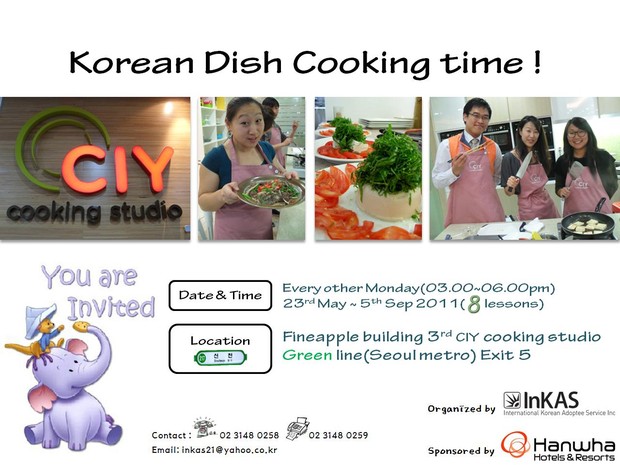
Korean Dish Cooking Class is not a new event that InKAS has organised, Let's gather together and have fun while cooking with your friends!During lectures, various famous traditional Korean dishs will be cooked with great guidance by professional teachers at CIY studio. The menu have not confirmed yet, but it might be various dishes that enhance your fun and interest in Korean Food!!!...
The event schedule will be as below, please double check with some important NOTICE as well
1. Date&Time: Every other
Monday 04.00~06.30pm
during 23rd of May~ 5th of September 2011
2. Location: Fineapple building 3rd Floor CIY cooking Studio (Green line-Seoul metro) Sincheon station exit 5 then 1 min walk distance
3. Possible applicant: ONLY Korean Adoptees !!
4. Import
notice!!!
* Only Korean adoptees will be accepted
For more info.
contrat: Tel: 02 3148 0258 / Fax: 02 3148 0259 or email to inkas21@yahoo.co.kr /
visit inkas website: www.InKAS.org
Please e-mail InKAS with your phone number if you would like to join this class. inkas21@yahoo.co.kr
This event will be sponsored by 한화호텔&리조트(HanwhaHotel&Resorts)
Written by on date 2011-05-11 in Notices .
InKAS has now opened a forum section where you can post your questions and share knowledge with other members. So please post your questions or opionions there, eg about scholarship, motherland tour or any issues, and along with the more experienced members we hope to provide the information and have a open dialog that will contribue to a more transparent organization. Note that the forum is a public place but you can also send private messages to other members.
Hope this will be to good use, and go ahead give us feedback if there is something you have in mind.
Written by on date 2011-05-02 in Korean History .
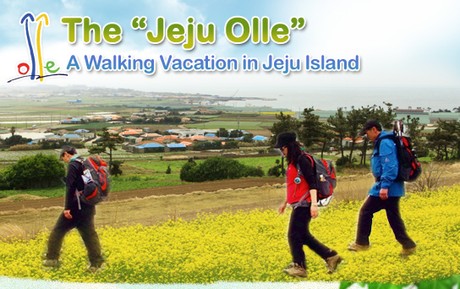
For the global traveler looking for a unique destination, the olle walking paths on Jeju Island are highly appealing.
These are 200km of connecting paths that will take travelers all along the south coast of Jeju Island. The Jeju Olle, which
were inspired by the famous Pilgrim’s Trail in Spain, was made from the hidden, forgotten routes of Jeju Island, which
cars cannot access.The route will take you to forests, mountains, beaches, and remote places and offer unrivalled
views over Jeju’s unique, dramatic, volcanic landscape.
With so many activities on offer in Jeju, it is not easy to say which is best, however the Jeju Olle walking paths must rank highly. By the end of 2008, some 30,000 visitors have been to the paths, including a number of celebrities in Korea. They offer the chance to experience life at a slower pace and are a total escape from the hustle and bustle of city life. Most of the paths are away from urbanized areas, and walkers are totally surrounded by nature and the tranquility. Some of the areas are almost untouched, since this is the first time some paths have been open to the public.
The paths are connected, so you can start your walk from where you finished the previous day. The route is divided into twelve sections, which will take you through along forests, beaches, and villages, where you can meet the warmhearted local people. We’ve provided an introduction to the paths, so you can choose which sections are best suited to you, or you can take a twelve-day trip and do all of them. Walking the Jeju olle paths will refresh you, inspire you, and leave memories you’ll never forget.
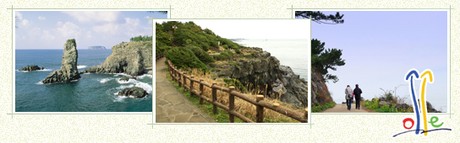
In the local Jeju dialect "Olle" was originally used to refer to the narrow path between between the street and one’s doorstep. In the past, the word was quite commonly used, as children would often say, “let’s meet at the olle”. However, later this word came to be used more widely across Korea and the word came to mean the series of coastal walking paths in Jeju Island. The olle walking paths of Jeju start at the east point of the island and wind their way along the coast all the way to the island’s southwest point. The charms of the olle walking paths are their proximity to nature and the picturesque combination of the blue ocean, dark green forests, and the charming local villages.
The first of these walking paths opened in September 2007.As of March 2009, some 13 walking paths had been completed, 12 main paths and one “alpha” path. The walking paths collectively stretch to a length of approximately 216km. The olle are paths that have developed naturally over the years. They have been connected to each other using minimal human intervention. Depending on the pace of the individual or group, each route will take roughly four to six hours. Walking along these small paths that take you through the mountains and along the coast is the best way to experience the unique, startling beauty of Jeju Island.

Tip 1. Following an Olle Walking Path!
Blue or blue and yellow ribbons have been placed along an olle path to guide visitors. These are found throughout the route usually along the stone piled walls, rocks, or on the surface of the road.
Tip 2. Bathrooms and Restaurants!!
As the olle have been arranged in an eco-friendly manner, there
are not many toilets or restaurants along the way. However, convenience
facilities can be found at the beginning or end of each path. Do take
water and snacks with you.
Tip 3. What to Prepare!*Shoes: visitors are advised to wear exercise or climbing shoes. During
the summer, sandals will also be useful to walk along the beach area.
Extra
Layers: Although the weather on Jeju-do is generally warm and pleasant,
it is often windy and there are frequently unexpected showers. Walkers
are advised to carry waterproof clothing and an extra, long-sleeved
outfit with them.
Guidebook: A guidebook is available free of charge
at the Information Desk of the Jeju International Airport. The guidebook
will include useful information on the Olle walking paths,
accommodation, and restaurants.
Written by on date 2011-05-02 in Korean History .
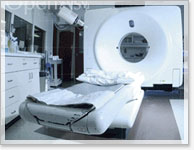
In Korea, you’ll be able to take advantage of convenient and highly developed one-stop services.
As you go through your examination and receive treatment, your medical records will automatically be saved in a cutting-edge, computerized health network system. This information may be accessed by other health facilities, meaning that you can easily switch your treatment location without having to go through endless paperwork.
Korea is an international forerunner in the field of robotic surgery. Robotic surgery is performed using a robotic arm that rotates 360 degrees and enables surgeons to see 3D images at 20x magnification. The robotic arm is particularly effective in the treatment of cancerous tumors because it can remove cancerous cells located in very thin and intricately intertwined lymph nodes. In the case of thyroid surgery, thanks to the robotic arm, the incision is less than one centimeter long and the scar is almost invisible.
Korea offers premium high-tech medical services by combining advanced IT and biotechnology, continuing to make significant advancements in the field of medicine.


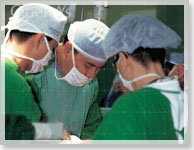
In Korea, the standard of medical excellence is so stringent that only the top 0.5% of medical students can pass the regorous exams and go on to become practicing professionals. When you come to Korea for your medical needs, you can be assured that you are in the most capable of hands.
The cost of medical services in Korea is very low compared to those in the USA and Japan. For example, hemorrhoid surgery in the USA costs approximately 10.91 million won while for a fraction of the cost (roughly 1.27 million won) you can get the same, if not superior, treatment in Korea. Some cancer treatments in Korea cost half of what you would pay in Singapore or Thailand.
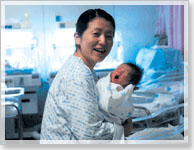
Our bodies are very sensitive to the weather. After surgery, excessive
exposure to sunlight can worsen scarring or cause you to heal more slowly. You
may even experience infection or inflammation after surgeries that are performed
in hot and humid
climates.
These weather-related complications, however,
are not an issue in Korea. Korea has four distinct seasons and the weather is
pleasant throughout most of the year, with just enough sunlight and gentle
breezes to aid you in your
recovery.
Written by on date 2011-05-02 in Korean History .
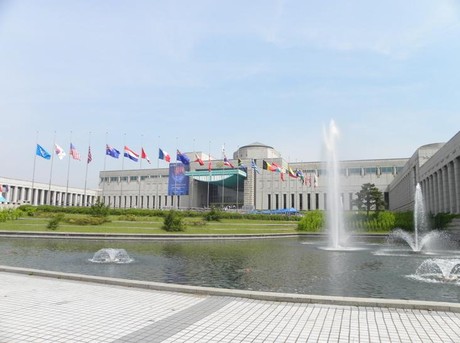
http://english.visitkorea.or.kr/enu/SI/SI_EN_3_1_1_1.jsp?cid=268131
The grounds of the War Memorial of Korea were once the headquarters of the Korean Infantry. Many experts from different fields were consulted numerous times and exhaustive research was done in order to complete the exhibits. This memorial is the largest of its kind in the world.
There are 8 main exhibits at the War Memorial: the Hogukchumo Exhibit, War History Exhibit, June 25th War Exhibit, Overseas Dispatched Troops Exhibits, Military Development Exhibit, Large Equipment Exhibit, and the Outdoor Exhibit. The Hogukchumo Exhibit honors the spirit of those who perished fighting on the battlefield. Visitors can learn all about Korea’s war history by visiting the War History Exhibit, June 25 War Exhibit, Overseas Dispatched Troops Exhibits, and the Military Development Exhibit, as well as witness how the Korean military developed over the years. Different kinds of weapons and military equipment are exhibited as well, inside and outside the building.
Exhibits inside the building display equipment used during the Korean War in such a way as to invite comparison between the items. Large weapontry and equipment used by different countries during World War II and the Vietnam War are also on display. In the Large Equipment Exhibit on the second floor, many kinds of defense industry equipment and both real and model weapons are displayed. In the Bangsan Equipment Exhibit, you can look at weapons and war equipment produced in Korea. In the War Memorial’s Storage Room, 17,800 files and artifacts of war are preserved. Modern damage control and prevention devices have been installed to keep these materials safe from harm.
Besides these, you can also visit the Miniature Exhibit or the Peace Hall. There is a lecture hall at the memorial, and many presentations are held here. If you want to learn more about any specific aspect of war, you can head over to the bookstore to pick up a book or a pamphlet. The shop also sells a variety of military souvenirs that will not only help you remember your time at the memorial but will also remind you of the significant role war has played in world history. The memorial also has a fast food restaurant and stores located outside the building.
This an exhibition hall dedicated to the memory of patriots involved in past war efforts. The place presents sculptures, reliefs, and wall paintings under the theme of overcoming hardship, and working towards the unity, prosperity and eternity of the nation.
The place features a war history from prehistoric era to the Japanese colonial period. Military remains, relics, and documents are on display as well. Among them are war & victory records, ammunition, the Turtle Ship (and other military vessels from the Joseon Dynasty), fortress models, and more.
Here, visitors can learn about the background of the Korean War, the progression of the war and how a truce was eventually established. Exhibits also display ammunition used by hostile and friendly forces, information and artifacts from people displaced by the war, and information on major battles.
Information in this exhibit describes the Vietnam War and the implication of Korean dispatch to Vietnam. Other information explains the activities Korean troops were mainly engaged in during the Vietnam War, the tactics of the Viet Cong, The Gulf War, PKO dispatch to Somalia, and more.
The place presents documents on the Korean Army, Navy, Air Force and Marine Corps from the time of their inception till today.
Replicas of state-of-the-art weapons that are produced by domestic companies are on display. Items include fighters, submarines, destroyers, and communication apparatuses.
Around 110 pieces of large military equipment/symbols are on display. They include Korean War sculptures, the Statue of Brethren, the Statue of King Gwanggaeto, AH-2, T-34 of the North, US B-52 and others.
Screening Room, Cultural Theater etc.
Free
1,000 spaces
- Vehicles with less than 15 passengers : 2,000 won for first 2Hrs / 1,000 won for every 30min after
- Vehicles with more than 16 passengers : 10,000 won for first 2Hrs / 3,000 won for every 30min after
English, Japanese, Chinese (Audio guide rental)
Written by on date 2011-05-02 in Korean History .
The seonbi spirit
When you are tired of apartment buildings, shopping centers, and even traditional markets, it is always lovely to stroll around some of the oldest parts of Seoul. There are sites here that stretch back into the past and connect the city's present with the endless stream of life that has flowed through this place for millennia. The grandest of all Seoul's palaces, the Gyeongbokgung Palace compound, is so massive that you can never see it all in one visit. Its accessibility and cheap entry price make it worth revisiting at least once a season; every trip is bound to yield some new delights. Construction on the palace began in 1934, after Seoul was chosen as the capital of the Joseon Dynasty. During the Japanese colonial period (1910-1945), more than half the existing buildings were destroyed. However, many of the more majestic structures still stand or have been reconstructed. The traditional changing of the guard ceremonies are recreated several times each day before the imposing Gwanghwamun Gate, whose reconstruction was completed just last August. On top of its countless treasures to be discovered, the palace compound also houses the National Palace Museum of Korea and the National Folk Museum of Korea.
Where to Eat
There is a little alley running perpendicular to the western outer wall of Gyeongbokgung compound that has some very tasty and affordable Korean restaurants - Saemaeul-Sikdang, a kimchi jjigae specialty house, and a place famous for its broiled fish. Just come out of the west gate ad go down the alley almost directly across the road.
Getting There
Gyeongbokgung Station Line 3, Exit 5. Or, for a scenic route, come out of Gwanghwamun Station, Exit 5, to Gwanghwamun Plaza and walk all the way up to the main gate of the palace.
All-Inclusive Ticket
An all-inclusive ticket (10,000 won, valid for 1 month) for Seoul's four major palaces (Gyeongbokgung, Changdeokgung, Changgyeonggung, and Deoksugung) and Jongmyo Shrine is available at the ticket offices of all these five destinations.
More Info
Website: www.royalpalace.go.krT. (02) 723-4283. Closed every Tuesday. Open 9am-6pm (Mar-Oct) and 9am-5pm (Nov-Feb). Open until 7pm on weekends and national holidays (May-Aug). Admission 3,000 won for adults, 1,500 won for children. Free guided tours (about one hour) are available from inside the gate where you show your ticket. Call ahead for groups of 10 or more.
The most accessible of old Seoul's gates
Seoul was once a citadel, a city surrounded by 18 kilometers of wall. Four large and four small gates provided access to the nation's capital. Of the four large gates in each of the cardinal directions, only those in the north and east stand unscathed (the west gate is gone, and the south gate was damaged by arson in 2008). Dongdaemun ("the great east gate") is known as Heunginjimun, literally "gate of rising benevolence." The first gate was built in 1396 during the reign of King Taejo, the first monarch of the Joseon Dynasty. The portal currently standing was built in 1869. The neighborhood is now better known for the fashion shopping district that sprang up just nearby, but the gate is unmissable, sitting incongruously at the intersection of some of Seoul's busier streets. The gate itself is not usually open to public access, but it is possible to navigate your way around it and admire the centuries-old walls partly overgrown with ivy. Just north of the gate is part of the old city wall, demolished to allow for the city's expanding girth. Some of it was used to build what followed - a church just opposite the gate sits upon the wall's foundations. You can hike along the wall up to Mt. Naksan Park. South of the gate, at Dongdaemun History and Culture Park, another section of the wall has recently been restored and is now open to the public.
Try the street food tents just across from the fashion market, south of the gate. There are lots of cheap and tasty eats there, and the atmosphere is convivial, especially at night.
Dongdaemun Station, Lines 1&4, Exit 6. To find the remnants of the old city wall, take the road immediately north of the gate, to the right of one church and leading toward another church. Look for the path that comes off to the left.
Where ancestral music is still played
Jongmyo is the royal shrine of the Joseon Dynasty. Here, nineteen kings and thirty of their wives are memorialized. Their bodies are not here - just their name tablets. It is these stone tablets that were the objects of Confucian rituals of ancestor reverence. Jongmyo was built in 1934, the same year as Gyeongbokgung. Over the years, the shrine was extended to accommodate more deceased kings and their consorts. The entire complex was rebuilt in 1601 after being burnt down by Japanese invaders. A beautiful tradition of music and dance developed in the rite, which is still held on the first Sunday of each May, called the Jongmyo Jerye. Performers dressed as royal servants play court music, Jerye-ak, and the late monarchs of Korea are venerated. This music and rite were recognized in 2001 as the first of Korea's Masterpieces of the Oral and Intangible Heritage of Humanity by UNESCO. Other ceremonies and performances are held there five times a year. Even on a non-ceremonial day, Jongmyo is impressive as the longest building ever built in the traditional Korean style, facing a massive courtyard measuring 100 by 150 meters. It was added to UNESCO's World Heritage list in 1995.
On weekdays and Sundays (except Tuesdays, when it is closed), admission to Jongmyo is only allowed for guided tours. English tours are at 10am and 11am, and at 2pm and 3pm. Call (02) 765-0195 to reserve a place, or have a Korean friend do it on the website. Every Saturday, it is open to visitors without guided tours. Opening hours are 9am-6pm (Mar-Sept) and 9am-5:30pm (Oct-Feb). Entry costs 1,000 won for adults and 500 won for children. Website: http://jm.cha.go.kr
Try the handmade noodles (kalguksu) or dumpling soup (manduguk) in the small restaurant above the pharmacy (cheerfully labeled "Have a healthy day") outside Exit 8 of Jongno 3-ga Station.
Jongmyo is within five minutes' walk of Jongno 3-ga Station. From Line 1, take Exit 11 (walk straight and take the first road to the left); from Line 3 or 5, take Exit 8 (walk straight and then follow the road to the right).
Jeong-dong - where the east first met west
This quiet street, running from the side wall of Deoksugung Palace up to where Seodaemun, the Great West Gate, once stood, still resonates with the history of early modern Korea. Many of Seoul's first encounters with Wester education, medicine, diplomacy, imperialism, and religion took place here on the western edge of the walled city. It was at the former Russian Legation that the penultimate Joseon monarch, King Gojong, spent a year after his wife, Queen Min, was assassinated. Nearby, the first western-style hotel in Seoul, the Sontag Hotel, was built. The beautiful Jungmyeongjeon, recently restored, was once the King's library and part of Deoksugung before becoming a banquet hall, then the location of the treaty that made Korea a Japanese protectorate, and later on the foreigners-only Seoul Club. In this neighborhood, you will also find Korea's oldest Protestant churches, the U.S. Embassy residence, the first girls' high school in Korea, and much more. There is an abundance of charming places to eat and stop for a coffee along the way.
For a more informative walk, follow Tour 2 of "Seoul's Historic Walks" by Chou Insouk and Robert Koehler.
Since you are in Jeong-dong, it makes sense to try some foreign food. The Brazilians may not have been there in 1900, but they have a restaurant there now called Ipanema, serving all-you-can-eat Brazilian barbecue. Opposite the Canadian Embassy and up the hill a little.
The neighborhood of Jeong-dong can be reached on foot from City Hall Station, Lines 1&2. Take exit 1, turn 180 degrees, and take the first left turn. Follow the wall of Deoksugung Palace along to the roundabout and take the middle road.
-The article courtesy of Seoul magazine
http://english.visitkorea.or.kr/enu/SI/SI_EN_3_6.jsp?gotoPage=14&cid=1134708&out_service=
Written by on date 2011-05-02 in Korean Lifestyle .
Traditional Korean thought
Traditional Korean thought has been influenced by a number of religious and philosophical thought-systems over the years. As the main influences on life in Korea, often Korean Shamanism, Buddhism, and Confucianism. These movements have shaped Korean life and thought.
Shamanism
Traditional rites and shamanistic practices have developed in Korea for millennia. Throughout Korean history, native shamanism deeply influenced and was influenced by Buddhism and Taoism. In contemporary Korean, a shaman is known as a mudang.
Even though belief in Korean shamanism is not as widespread as it once was, the practices are kept alive. The mudang seeks to solve human problems through a connection to the spirits. This can be seen clearly in the various types of gut that are still widely performed.
Buddhism
Korean Buddhist thinkers refined ideas originally introduced from China into a distinct form. The Three Kingdoms of Korea introduced Buddhism to Japan, from where it was popularized in the West. Korean Buddhism consists mostly of the Seon lineage, which is derivative of the Chen (Zen) Buddhism of China and precursor to Zen Buddhism known in the West through Japan.
Buddhist temples can be found in most parts of Korea and many are considered national treasures.
Haeinsa is a Buddhist temple in South Gyeongsang.
Confucianism
One of the most substantial influences in Korean intellectual history was the introduction of Confucian thought as part of the cultural exchange from China. Today the legacy of Confucianism remains a fundamental part of Korean society, shaping the moral system, the way of life, social relations between old and young, and high culture, and even survived the modernization of the legal system.
http://en.wikipedia.org/wiki/Traditional_Korean_thought
Written by on date 2011-05-02 in Korean Culture .
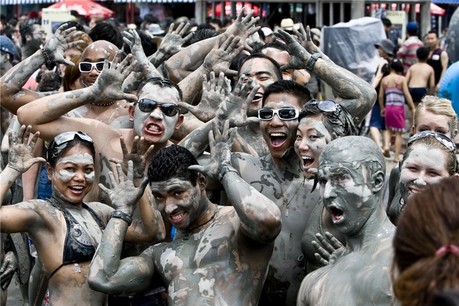
The Boryeong Mud Festival is an annual festival which takes place during the summer in Boryeong, a town around 200 km south of Seoul, South Korea. The first Mud Festival was staged in 1998 and, by 2007, the festival attracted 2.2 million visitors to Boryeong.
The mud is taken from the Boryeong mud flats, and trucked to the Daecheon beach area, where it is used as the centrepiece of the 'Mud Experience Land'. The mud is considered rich in minerals and used to manufacture cosmetics. The festival was originally conceived as a marketing vehicle for Boryeong mud cosmetics.
Although the festival takes place over a period of around two weeks, it is most famous for its final weekend, which is popular with Korea's western population. The final weekend of the festival usually falls on the second weekend in July.
History of the Festival
In 1996 a range of cosmetics was produced using mud from the Boryeong mud flats. The cosmetics were said to be full of minerals, bentonites, and germaniums, all of which occur naturally in the mud from the area.
In order to promote these cosmetics, the Boryeong Mud Festival was conceived. Through this festival, it was hoped people would learn more about the mud and the cosmetics. The festival has become popular with both Koreans and western tourists, as well as American Military personnel stationed in the country, and foreign English teachers working in Korea.
The festival attracted some controversy in 2009 when a group of school children attending the festival developed skin rashes after contact with the mud.
Attractions
For the period of the festival several large attractions are erected in the seafront area of Daecheon. These include a mud pool, mud slides, mud prison and mud skiing competitions. Colored mud is also produced for body painting. A large stage is erected on the beach, which is used for live music, competitions and various other visual attractions.
A small market runs along the seafront selling cosmetics made using the mud from Boryeong. Various health and beauty clinics offer massages, acupuncture and other treatments utilising the medicinal qualities of the mud.
The festival is closed with a large firework display.
http://en.wikipedia.org/wiki/Mud_festival
Written by on date 2011-05-02 in Korean Culture .
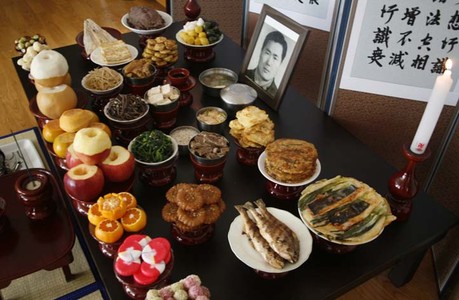
Jesa is a ceremony commonly practiced in Korea. Jesa functions as a memorial to the ancestors of the participants. Jesa are usually held on the anniversary of the ancestor's death.
Kinds of ancestor rituals
There are several kinds of ancestor rituals such as gijesa (기제사), charye (차례), seongmyo (성묘), myosa (묘사). Gijesa is a memorial service which is held on the day of the ancestor's death every year. Gijesa is performed until upwards of four generations of ancestors in the eldest descendant's house. Memorial services that are performed on Chuseok or New Year's Day are called "charye," On April 5th and before Chuseok, Koreans visit the tombs of their ancestors and cut the grass off the tombs. Then, they offer food, fruits, and wine, and finally make bows in front of the tombs. Memorial services that are performed in front of tombs are called "seongmyo". Finally Myosa are performed at the tomb site in the lunar month of October to conduct in memory of old ancestors (five or more generations).
Performance
To perform ancestor rituals, the family at the eldest son's house prepare many kinds of food such as wine, taro soup, beef, fish, three different colored vegetables, many kinds of fruits, and rice cake or songpyon.
After midnight or in the evening the descendants set the shrine and in front of the shrine they set up written prayer. Several ritual greetings (kangshin) then follow. The first entails an offering of rice wine; a designed attendant then, recite a written prayer. At the conclusion of the first ritual offering, the eldest son would show his respects by performing a ritual bow twice. Then these things are followed by next eldest sons, sons-in law. When all the ritual offerings are made, all the attendants at the ceremony bow twice and the spirits are sent off until the next year. The table with the food and wine offerings is then cleared and the written prayer recited earlier on during the ceremony is set a fire.
Once all of these steps are completed, the feasting of the food and wine (or umbok) by the family members follows. Consuming the ritual food and wine is considered to be an integral part of the ceremony, as it symbolizes the receiving of the blessings bestowed upon the family.
Modern ancestor rituals
Ancestor worship has changed much in recent years. These days it is common to hold ancestor rituals up to only two generations of ancestors, and in some cases, people only hold rituals for their dead parents. In addition, more people are holding rituals in the evening, not after midnight. People can also perform ancestor rituals in a younger son's house.
Today, in most Korean families, ancestor rituals still remain an important part of their culture and they are faithfully observed. These ancestor rituals, in spite of revised form, continue to play an important part in modern Korean society, which testifies to their inherent importance in the lives of Koreans.
http://en.wikipedia.org/wiki/Jesa
Written by on date 2011-05-02 in Korean Lifestyle .

Global Leadership is the interdisciplinary study of the key elements that future leaders in all realms of the human experience should acquire to effectively familiarize themselves with the psychological, physiological, geographical, geopolitical, anthropological and sociological effects of globalization. As a result of trends, starting with colonialism and perpetuated by the increase in communication, (brought about by the internet and other forms of human interaction based on the speed of computer-mediation) a host of meaningful new concerns face mankind; consisting of but not limited to: human enterprises, international business development and design, and significant shifts in geopolitical paradigms. The talent and insight it will take leaders to successfully navigate humanity through these developments have been collectively gathered around the phenomenon of globalization.
Global Leadership competencies
Global competencies include the following.
Recognizing differences in the world based on
Using technology to make and maintain truly global connections by maintaining
Cross-cultural Competency (C3)
A set of 40 general cross-cultural learning statements (knowledge, skills, and personal characteristics) were recommended by a DoD focus group in order to foster the career development of cross-cultural competence in military and civilian personnel.
The nine GLOBE cultural competencies are
Written by on date 2011-05-02 in Korean Lifestyle .
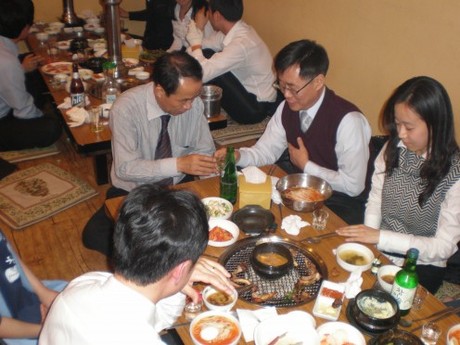
Dining etiquette
Dining etiquette in Korea can be traced back to the Confucian philosophies of the Joseon period. Guidebooks, such as Sasojeol (士小節, Elementary Etiquette for Scholar Families), written in 1775 by Yi Deokmu (李德懋), comment on the dining etiquette for the period. Suggestions include items such as "when you see a fat cow, goat, pig, or chicken, do not immediately speak of slaughtering, cooking or eating it", "when you are having a meal with others, do not speak of smelly or dirty things, such as boils or diarrhea," "when eating a meal, neither eat so slowly as to appear to be eating against your will nor so fast as if to be taking someone else's food. Do not throw chopsticks on the table. Spoons should not touch plates, making a clashing sound" amongst many other recommendations which emphasized proper table etiquette.
The eldest male at the table was always served first, commonly served to them in the men's quarters by the women of the house. Women usually dined in a separate portion of the house after the men were served. The eldest men or women always ate before the younger family members. The meal was usually quiet, as conversation was discouraged during meals. In modern times, these rules have become lax, as families usually dine together now and use the time to converse. Of the remaining elements of this decorum, one is that the younger members of the table should not pick up their chopsticks or start eating before the elders of the table.
In Korea, unlike in China and Japan, the rice bowl is not lifted from the table when eating from it. This is due to the fact that each diner is given a metal spoon along with the chopsticks known collectively as sujeo. The use of the spoon for eating rice and soups is expected. There are rules which reflect the decorum of sharing communal side dishes; rules include not picking through the dishes for certain items while leaving others, and the spoon used should be clean, because usually diners put their spoons in the same serving bowl on the table. Diners should also cover their mouths when using a toothpick after the meal.
The table setup is important as well, and individual place settings, moving from the diner's left should be as follows: rice bowl, spoon, then chopsticks. Hot foods are set to the right side of the table, with the cold foods to the left. Soup must remain on the right side of the diner along with stews. Vegetables remain on the left along with the rice, and kimchi is set to the back while sauces remain in the front.
Korean chopsticks made of silver.
Drinking etiquette
The manner of drinking alcoholic drinks at dining is particularly important in Korean dining etiquette. Each diner is expected to face away from the eldest male and cover his mouth when drinking alcohol. In the most formal situations, when the eldest male offers a drink, the diner should politely refuse it three times. After three refusals, when the eldest male offers one more time, then finally the diner can receive it.
Written by on date 2011-04-14 in Pictures .
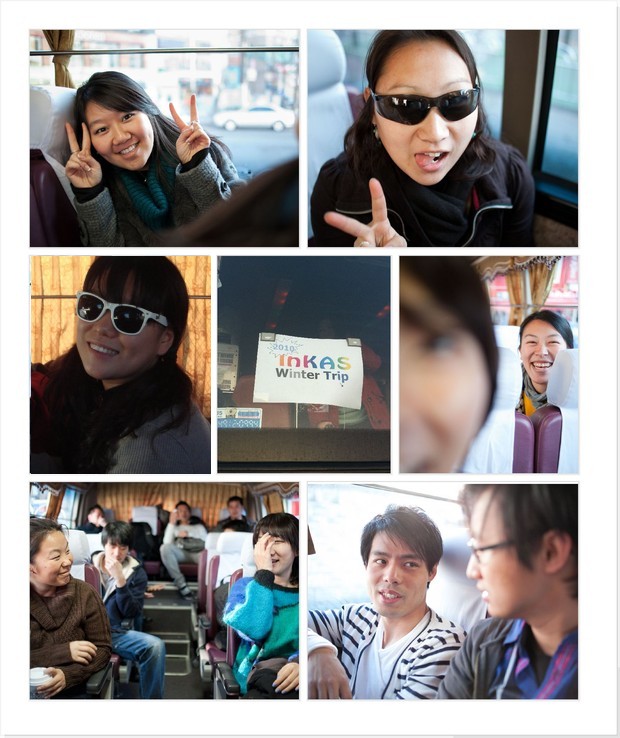
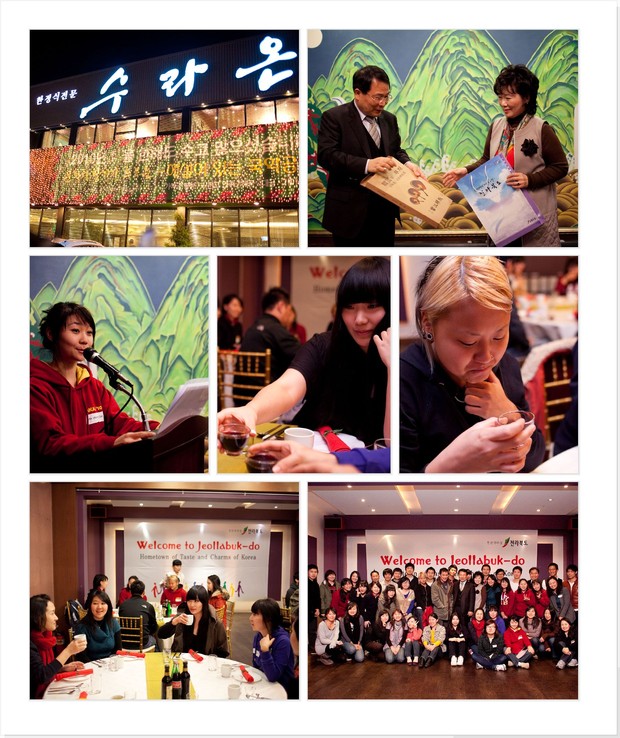
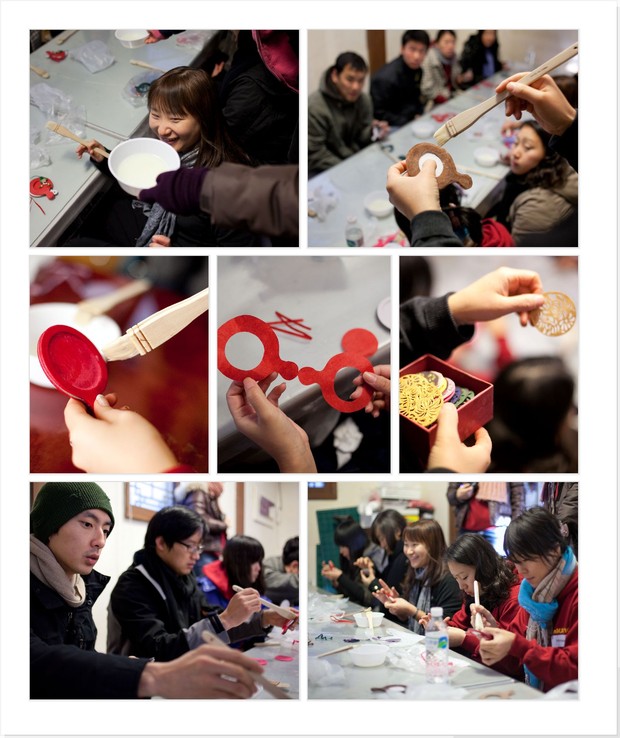
2010.12.3~ 12.5
2010 InKAS Fall/Winter Trip in Jeonju & Muju ♥
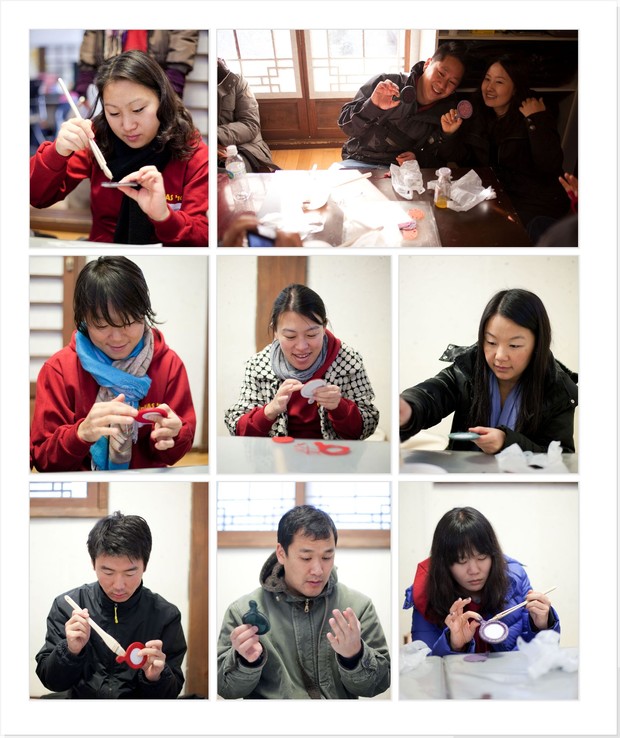
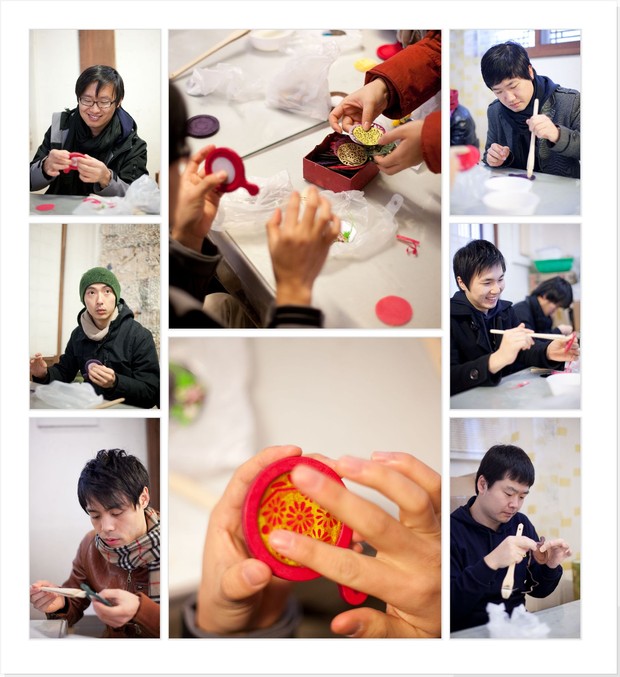
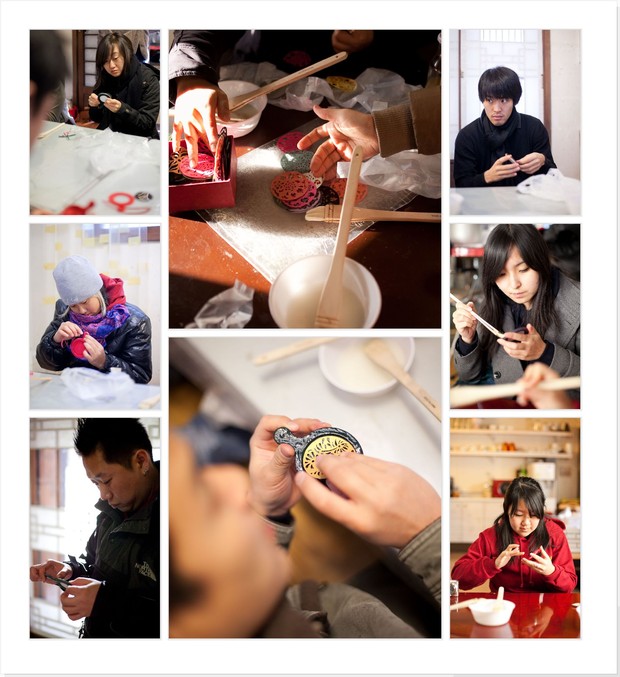
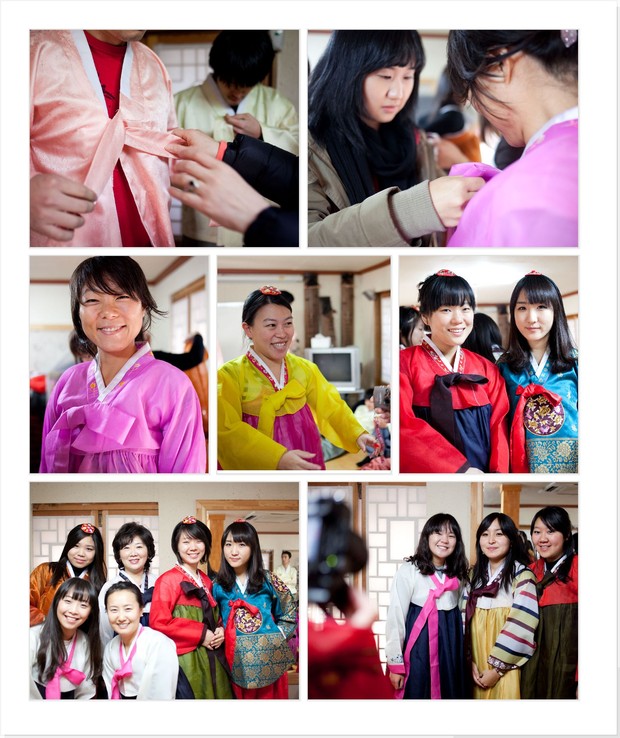
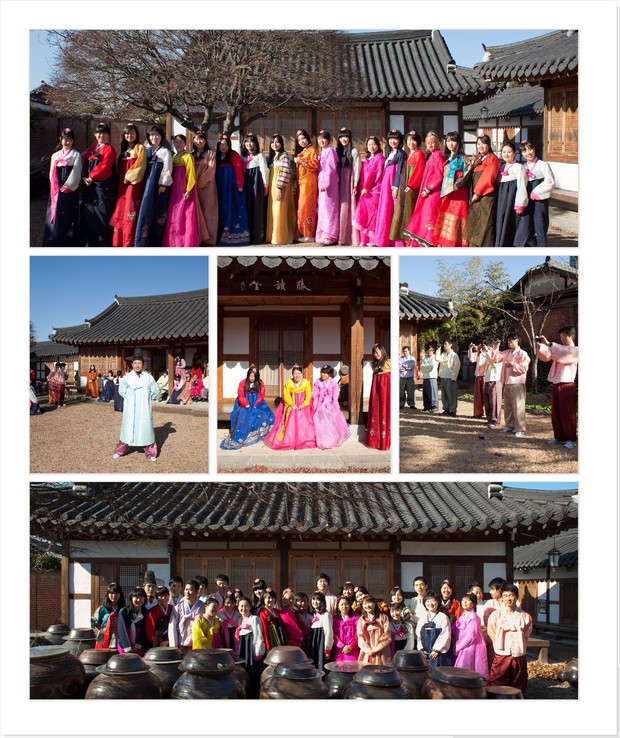
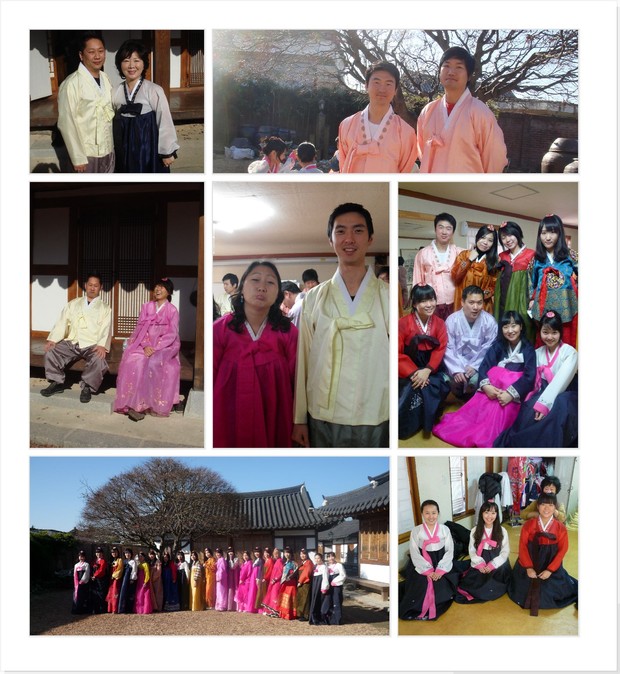
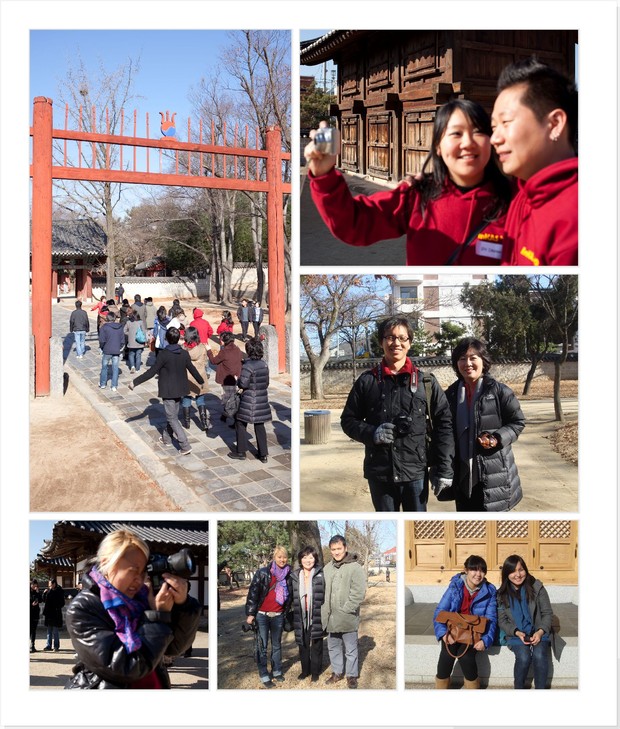
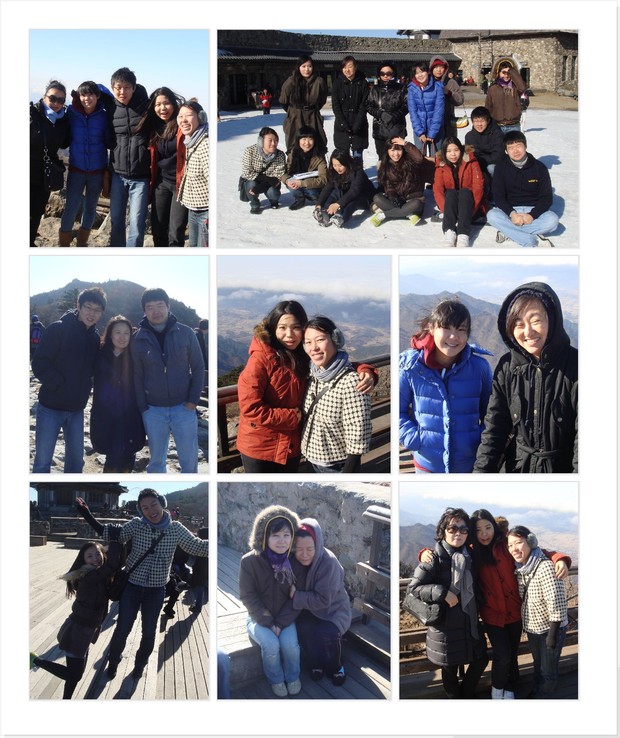
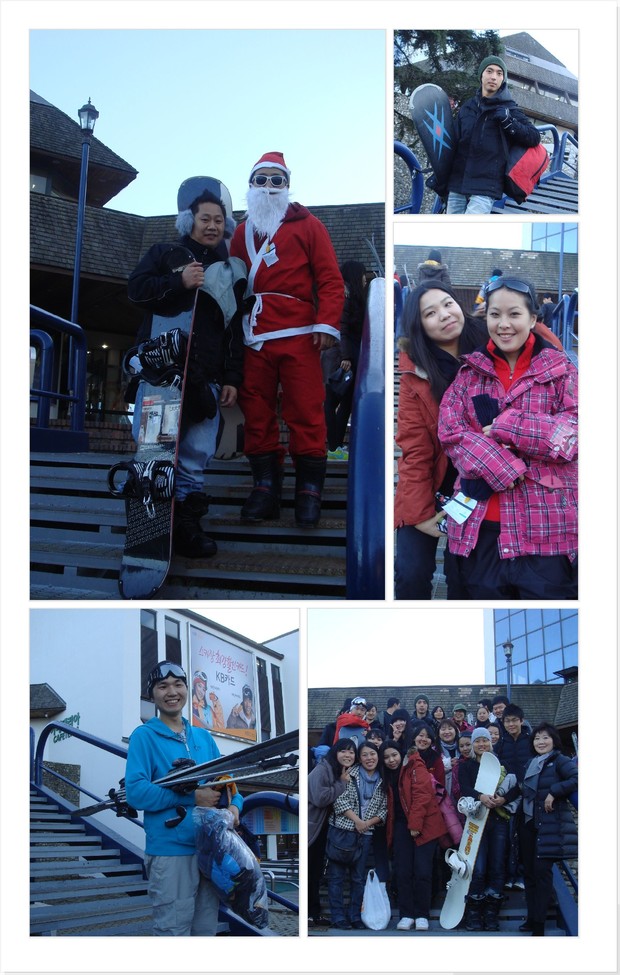
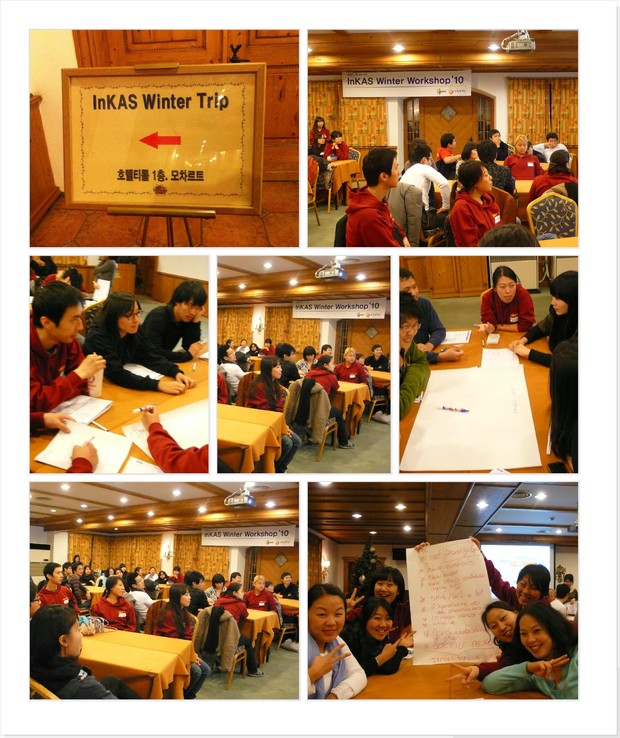
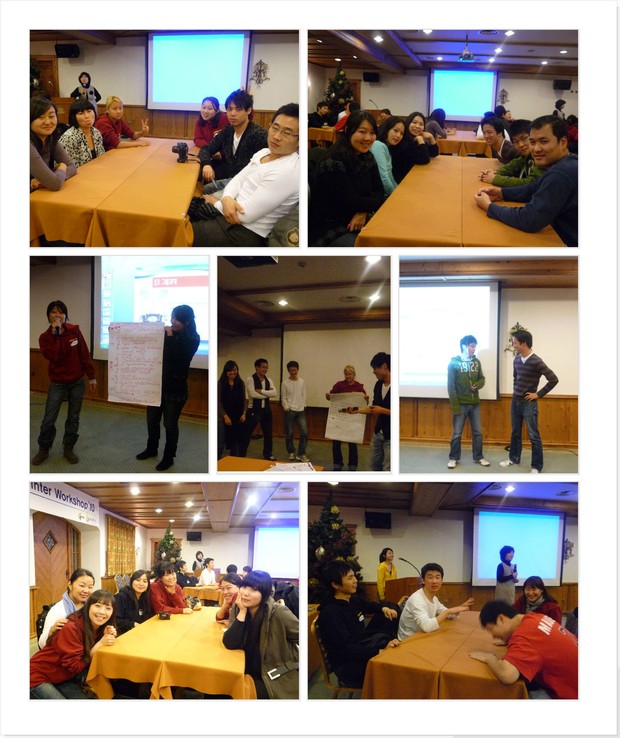
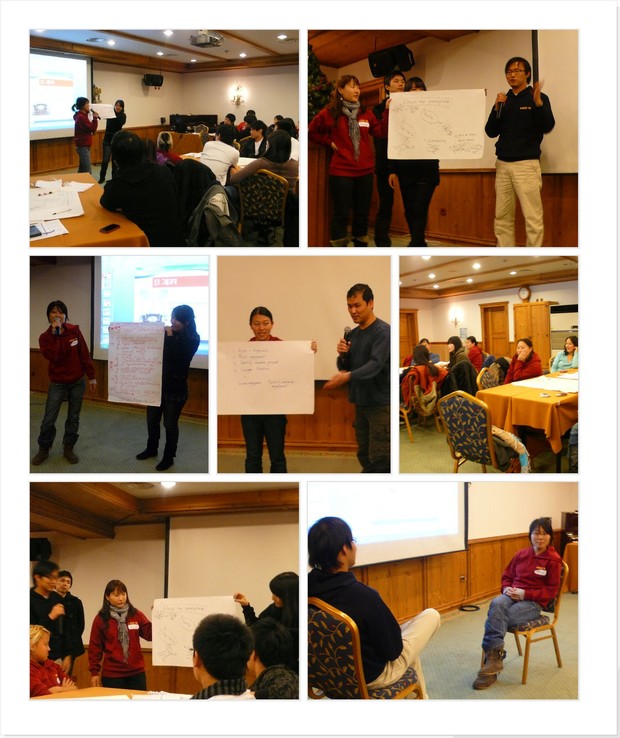
Written by on date 2011-04-08 in Notices .
InKAS has now opened a new website!! :D
We hope that this new site will make it easier for you to navigate and find the information you are looking for. Also when applying for services we have made it easier have a overview of what services are available and the status of your application, you will find this in My Applications. We will be continuously updating the website with fresh information and features to improve the communication with the InKAS members.
Please take a good look at My Account page and correct the missing or wrong information about you. Especially check your Type of member and select Adoptee or what ever your type of membership is. That would help us a lot. You can also see your payment status, a lot of our members haven't paid their membership due to some how complicated payment process. This should be easy enough and automatically updates your payment status so you can apply for InKAS services.
Note that the previous address www.inkas.or.kr will not be used anymore, www.inkas.org is now on the valid address.
The website is still fresh and as any other website unpredicted problems may occur, if so please notify us and we will fix it.
Our email is still the same, inkas21@yahoo.co.kr.
If you have any thoughts you would like to share, please leave a comment below (first login).
Written by on date 2011-04-07 in Pictures .
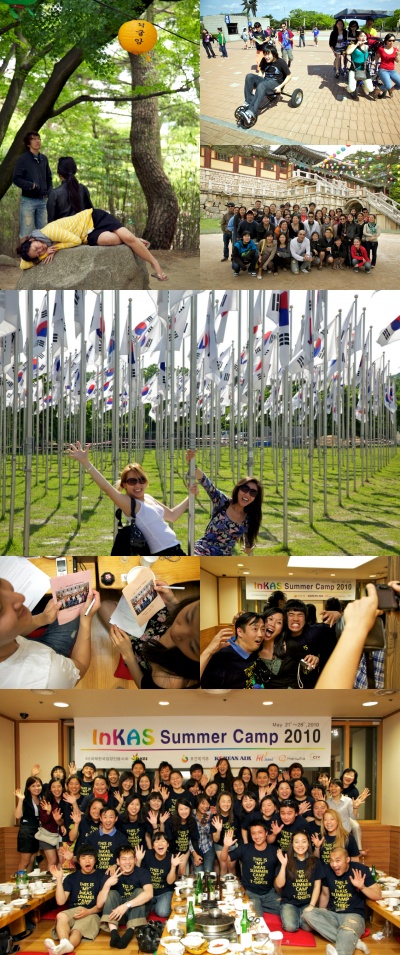
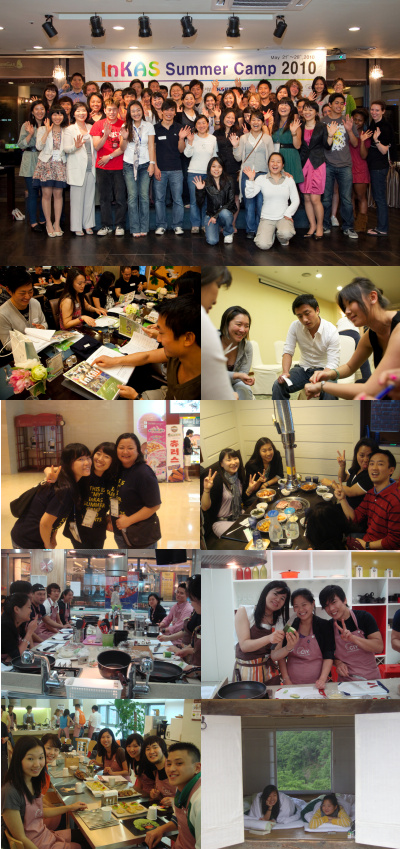
5/21~5/28 2010 InKAS Summer Camp ♥


InKAS - International Korean Adoptee Service Inc
contact@inkas.org | Phone: +82-2-3148-0258 | Fax: +82-2-3148-0259
(03698) 15F, 662, Gyeongin-ro, Guro-gu, Seoul, Republic of Korea


